
The Casting vs. The Calculus
It is a well-documented piece of Hollywood lore that James Cameron originally saw Arnold Schwarzenegger for the role of Kyle Reese. However, Cameron realized that Arnold’s imposing 6’2″ frame and deadpan delivery made him the ultimate “relentless, machine-like killer.” While this was a 10/10 decision for the film’s tension, it was a 0/10 decision for Skynet’s mission efficiency.
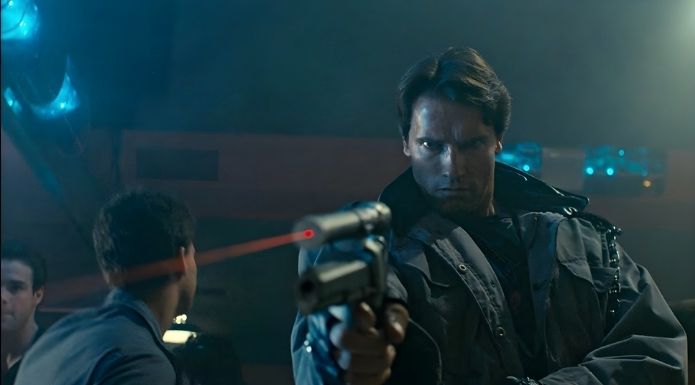
The Muscle Myth
From an engineering and mission standpoint, the Model 101’s physique is a Redundancy Error:
- Wasted Mass: A machine made of hyper-alloy doesn’t need biological pectorals to generate force. The “muscles” on a Terminator are purely cosmetic for infiltration purposes.
- The Infiltration Failure: Skynet’s goal was to kill Sarah Connor before the resistance could react. By choosing a body type that represents the top 0.01% of the human male physique, Skynet built a “stealth” unit that stands out in every room it enters.
- The “Grey Man” Logic: A truly logical AI would have sent a “Model 102″ that looked like a 5’9” insurance adjuster. A “Grey Man” could have walked up to Sarah Connor in a crowded diner without her ever looking twice. Instead, Skynet sent a world-class bodybuilder in a leather jacket who essentially announced “I am a threat” the moment he stepped off the sidewalk.
What would happen if the Terminator traveled back to the time of the dinosaurs? He’d battle a T-Rex, of course! Even Skynet can’t resist the Mesozoic Magnet: Why Time Travelers Always Find the T-Rex
The Logic of the Loud Entrance
While the action beats are cinematic gold, they represent a catastrophic failure in machine-led tactical planning.
1. The Tech Noir/Alibi Room Heist: The Terminator’s first priority is clothing. Logically, a stealth unit would acquire attire from a clothesline, a laundromat, or a quiet residential home. Instead, Skynet’s unit enters a biker bar (The Corral) completely naked, initiates a violent brawl, and leaves a trail of injured witnesses and a stolen motorcycle. By the time he is dressed, he is already a person of interest for the LAPD. It is the most conspicuous way possible to start a “covert” mission.
2. The Tech Noir Shootout: The scene where the T-800 enters the Tech Noir club to kill Sarah is an exercise in Narrative Invisibility. Despite being a 6’2″, 250lb man in a leather jacket and sunglasses at night, the film suggests he “blends in” until the moment he pulls the trigger.
- The Machine Logic Failure: Why initiate a shootout in a crowded club with high-security and hundreds of witnesses? A logical AI would have waited until Sarah was alone in the parking lot or her apartment. The “guns-a-blazing” approach provided Kyle Reese with the exact window of chaos he needed to intervene.
3. Overconfidence as a Bug: If Skynet’s logic was “He’s so indestructible it doesn’t matter,” then Skynet failed its own math. In a mission this vital, the “no-holds-barred” approach isn’t a show of strength, it’s a tactical vulnerability. The fact that the mission failed is direct evidence that Skynet’s “Movie Logic” was its undoing.
While the Terminator represents a failure in machine efficiency, The Kinetic Heat Paradox examines a failure in mechanical common sense. In my audit of Snowpiercer, I dismantle the “Motion is Life” myth, the idea that a society would choose to live on a 100mph train during an ice age instead of a stationary bunker. Much like Skynet sending a bodybuilder to be a “stealth” assassin, Wilford Industries chose the most dramatic, energy-inefficient solution possible because a well-insulated basement doesn’t make for a high-speed class war. Here, the social message is the core and the laws of thermodynamics are ignored to keep the metaphor on the tracks.
Terminator Evolution: The T-1000 Lesson
The transition to the T-1000 in the sequel suggests that the “Machine Mind” finally ran the numbers on its previous failure. Robert Patrick’s T-1000 was lean, average height, and, most importantly, mimicked a police officer. It swapped “Physical Intimidation” for “Institutional Invisibility.”
The Human Variable: Perhaps the T-1000 was the result of a different design philosophy entirely. If the logic was supposed to be a “Course Correction,” it feels less like a machine running numbers and more like a writer realizing that a stealth mission actually requires… well, stealth.
The Lethality Trade-Off: To compensate for the loss of Arnold’s raw bulk, Skynet equipped this model with liquid-metal composition. The ability to make his arms into giant stabby things or walk through security bars meant it didn’t need to be frightening at a distance; it only needed to be frightening once it was within striking range.
The Logic Paradox: But here is the ScreenLab question: Did Skynet actually “learn,” or was this just another stroke of movie-logic luck? If Skynet was as tactically incompetent as the first mission suggests, prioritizing naked biker brawls over quiet assassinations, it’s hard to believe the machine suddenly developed a nuanced understanding of “Institutional Invisibility.” This fundamental failure to apply machine logic suggests that Skynet’s “consciousness” is missing the very tactical processing it claims to possess, a theme I explore further in The Skynet / Matrix Paradox.