
We’ve all seen the Winchester brothers engage in their signature brand of “emotional” development, usually involving a “Jerk” from Dean and a “Bitch” from Sam. But after fifteen seasons of being telekinetically shoved across motel rooms, it’s clear their brotherly bond isn’t the only thing that’s unbreakable.
I’m starting to suspect that when they were kids, the “I’m rubber and you’re glue” taunt wasn’t just a playground insult, it was a supernatural hex. It’s the only logical explanation for why they can be launched 20 feet into a dresser, hit the floor, and get back up to reload. In the real world, the “bouncing” we see in Supernatural, or when Captain America kicks a pirate into a metal railing, or when Dom Toretto treats a car crash like a mild stumble, isn’t just “toughness.” It’s a complete violation of kinetic reality.
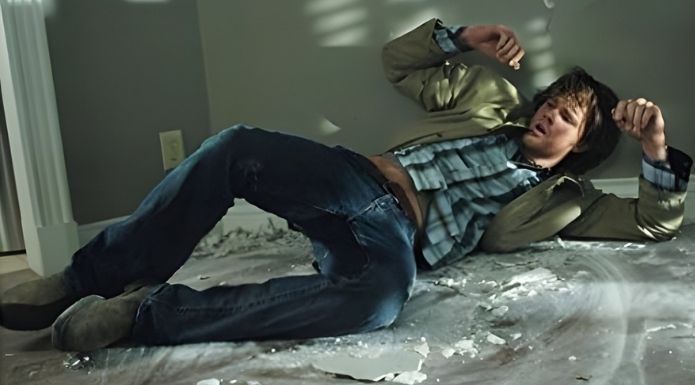
The Three-Story Room: A Injury Equivalency
To understand why these scenes are actually mass-casualty events, we have to look at the Ragdoll Paradox: the moment an external force is so great that the human musculoskeletal system can no longer maintain its own posture or structural tension. You aren’t “falling” in a controlled way; your body has been rendered into a literal ragdoll—a collection of weight and bone subject entirely to the whims of kinetic energy. But first, let’s look at the math of the “Sudden Stop.”
When a supernatural entity kicks you across a room at 30 mph, you aren’t just “falling over.” You are experiencing the horizontal equivalent of falling off a three-story building.
- The Drop Height: A 180 lbs man traveling at 30 mph has the same kinetic energy as someone hitting the pavement after a 30-foot drop.
- The Stop Distance: When you hit a wall, you don’t have a “crumple zone” and you cannot roll or try to distribute the force of the impact in any way. You stop in the space of about two inches (the depth of the drywall and your own ribcage).
- The Result: That impact generates approximately 180 Gs. For context, humans generally start dying at 50 Gs. At 180 Gs, your internal organs don’t just bruise; they undergo “total structural failure.”
The “Open Field” Fatalities: You Don’t Need a Wall
But wait, there’s more. You don’t even need a wall to be toast. A supernatural entity could launch you across an open field toward a soft, inviting lake, and you’re still likely heading for an emergency room—or a morgue—before you even hit the water.
The “Launch” vs. The “Memo”
As I mentioned before, the human body doesn’t move as a single, coordinated unit when it’s hit by a massive, instantaneous force. Your internal organs and your head didn’t get the “forward flying memo” that your torso just received.
- Internal Decapitation: Your head weighs about 10-11 pounds. When a demon or a super-soldier accelerates your body from 0 to 30 mph in a fraction of a second, your head stays put for a micro-second while your neck is whipped forward. This results in an internal decapitation, the ligaments and the spinal column are severed even if the skin remains intact.
- The Brain Slosh (Coup-Contrecoup): Even in an open field, your brain is floating in cerebrospinal fluid. Instant acceleration causes the brain to slam into the back of the skull. You are effectively concussed by your own skeleton before you’ve even traveled five feet.
The “Lake” Delusion
Action movies love the “falling into water” trope as a get-out-of-jail-free card. But at the velocities we’re talking about—the kind that can throw a grown man 25+ feet—water doesn’t feel like a pillow; it feels like concrete. If you are launched into a lake at 30 mph, the surface tension of the water provides a deceleration force that is nearly as violent as hitting the ground.
The “Human Skipping Stone” Effect
When you are launched at 30 mph toward a body of water, you aren’t “falling” into it; you are colliding with it at a shallow angle. This introduces Asymmetric Shearing Forces that would essentially treat your body like a wet rag in a blender.
- The Rotation Trap: Unless you hit the water in a perfectly flat, belly-flop orientation (which would just liquefy your organs anyway), one part of you is going to touch the surface first. If your leg hits the water at 30 mph while your torso is still flying forward, the water acts as a pivot point. The resulting Instant Roll would exert enough torque to snap the femur or pop the hip joint out of its socket instantly.
- The “Skip” vs. The “Slam”: At these velocities, the surface tension of the water doesn’t just “let you in.” Depending on your angle, you might “skip” like a flat rock. Every time you skip, you are slamming against a surface that, at 30 mph, has the structural resistance of a wooden floor.
- The Rolling Trauma: As you skip and roll, your limbs are flailing with zero structural support. This is where you see “centrifugal trauma”, your own arms and legs moving so fast they cause joint dislocations and soft tissue tears before you even come to a stop.
Specimen Update: The “Supernatural” Lake Escape
If Sam and Dean were ever launched into a lake by a high-level demon, they wouldn’t just swim to shore gasping for air. They would be “skipped” across the surface, experiencing multiple 50 G impacts, likely arriving at the shoreline as a collection of disjointed limbs and shattered vertebrae.
Related Specimen: The Relativistic Gait Paradox—Why The Flash has Younger Feet – The instant acceleration that liquefies a Winchester brother’s organs is the same force The Flash exerts every time he ‘saves’ a civilian. Barry Allen requires a ‘Physics Waiver’ (and the Speed Force) to keep his rescue missions from becoming unintentional executions.
The Super-Kick: The Puncture Paradox
We’ve all seen the YouTube videos debunking the “bullet launching a person backward” trope. We know that a bullet has a lot of momentum, but it’s concentrated in such a small area that it passes through the target rather than pushing it.
When Steve Rogers or a high-level Demon kicks someone across a room. Hell, we’ve seen regular humans do it with a regular side-kick. Well, that boot, at those superhuman speeds, effectively becomes a Giant Bullet.
- The Localized Rupture: If a boot is moving fast enough to launch 180 lbs of man 25 feet, it isn’t “shoving” the ribcage; it is caving it in. At that velocity, the sternum doesn’t stay intact; it shatters into a “huge dent” of bone shards that are then driven into the heart and lungs.
- The Abdominal “Through-and-Through”: If that super-kick hits the “soft parts” (the abdomen), there is no structural resistance to keep the body together. Physics dictates that the foot wouldn’t move the person; it would likely just go into or through the body.
The “True Force” Specimens
1. The Omni-Man “Train” Moment (Invincible)
If you want to see the “Ragdoll Paradox” completely dismantled, this is the gold standard.
- The Reality: When Omni-Man holds his son in front of a moving subway train, the people inside don’t fly across the room and groan. Because Omni-Man is an immovable object, the passengers hit him at high velocity and simply atomize. Their structural integrity is so far below the kinetic energy of the impact that they turn into a red mist.
- The “Gory Hyperbole” Disclaimer: Even in shows like Invincible, which we hold up as the “gold standard” for kinetic honesty, there is an element of exaggeration. While it’s closer to reality than the Winchesters’ rubber-ball physics.
- Narrative Extremism: Omni-Man on an extreme or “hyper-realistic” level.. The way bodies “atomize” or turn into perfect red mist is the show’s way of screaming, “Look how serious we are!” It’s still a stylistic choice, just one that lands on the opposite end of the spectrum from the “Cartoon Buffer.” However, in this case, Invincible is less “supernatural” than Supernatural, as it moves toward the “truth” of the kinetic consequences and then beyond them, instead of in the complete opposite direction.
2. The “Homelander Shove” (The Boys)
The Boys is essentially a bitch-slap response to the MCU.
- The Reality: When Homelander gets annoyed and “shoves” someone, he doesn’t launch them 20 feet. He usually accidentally (or purposefully) punches a hole through their shoulder or abdomen; or collapses their skull. The show understands the Puncture Paradox: at those speeds, a hand isn’t a blunt object; it’s a high-velocity drill. Of course, The Boys only pays attention to science when it wants to make fun of super-hero tropes.
3. The “Chest-Burster” or Slasher Punch
When a monster like a Xenomorph or a slasher villain (like Jason or a high-level Demon in Supernatural) actually punches through a ribcage:
- The Gory Truth: This is the most “honest” depiction of supernatural strength. It acknowledges that the force required to “throw” a man across a room is the same force required to liquefy his heart.
The Sanitized Slaughter: Why the Trope Persists
We have to ask ourselves why directors continue to lean on these kinetic impossibilities. The answer isn’t just that it looks “cool”—it’s that it makes the violence palatable.
Realistic violence is visceral, frightening, and deeply off-putting. If a “super-kick” actually did what the physics dictate, liquefying organs and caving in chests, the movie would shift from an action-adventure into a haunting body-horror film. By launching a character across a room like a rubber ball, the creators are engaging in a form of “Cartoon Buffer.”
The Emotional Shield: When we see Sam or Dean Winchester shake off a 180 G impact, our brains receive a signal: This isn’t real. This ridiculousness allows us to watch hours of “faux violence” without ever having a real, emotional reaction to the trauma being depicted.
- Watered-Down Stakes: The very over-the-top nature of the flight is what makes it easy to digest. It’s the “I’m rubber and you’re glue” logic applied to the audience’s empathy.
- The Hero’s Invincibility: If the hero can get up and reload after a three-story horizontal fall, we are no longer frightened for them. The tension is replaced by a predictable rhythm of impact and recovery.
The Structural Necessity of the “Rubber” Hero
It’s important to note that this isn’t necessarily a critique of shows like Supernatural, a show I adore just like every other fan! In a series where the protagonists literally treat death as a temporary inconvenience, biological realism is a hindrance, not a goal. Sam and Dean have to be invincible; the narrative necessitates it. If the Winchesters were subject to the actual laws of kinetics, the series would have been a ten-minute tragedy about two brothers who died of internal decapitation in a cheap motel.
Supernatural has never been accused of taking itself too seriously, and its “rubber-ball” physics are part of that DNA. This isn’t about what an audience can “handle”—it’s about the direction the show needs to go. By opting for “Cartoon Violence” over “Visceral Reality,” the creators ensure the focus remains on the banter and the brotherhood, rather than the horrific trauma of a shattered C-spine or a bloody gape-hole in Sam’s chest.
In the end, these tropes aren’t just mistakes; they’re the scaffolding that allows the “Invincible Hero” to exist. We accept the 180 G impacts because we want the story to continue. We just have to acknowledge that, for the Winchesters, “I’m rubber and you’re glue” isn’t just a taunt, it’s a survival strategy.