
In a recent video, Rebecca Watson (Skepchick) takes a deep dive into the claims of Graham Hancock, the man behind Netflix’s Ancient Apocalypse. Watson, alongside other skeptics, does a fine job of puncturing Hancock’s “lost civilization” theories. To be clear: this isn’t a critique of her facts. Her assessment of Hancock as a charlatan is spot on. However, there is a recurring misconception in these videos, one shared by the public and the academic community alike, that this is a battle of Science vs. Pseudoscience.
By calling Hancock a “pseudoscientist,” we’re making a massive assumption: that archaeology itself is a hard science. It isn’t. And that distinction is exactly why people like Hancock are able to mislead millions, including high-profile figures like Keanu Reeves.
The Clock Test: Why Debunking Hancock Takes an Hour
There is a simple clock test for true pseudoscience. If someone claims the earth is flat or that vaccines contain microchips, a specialist can dismantle the core claim in under five minutes using repeatable, hard data. Yet, the videos debunking Hancock are much longer. Rebecca Watson’s video is over 15 minutes long, and the potholer54 video she references, which only covers the first episode, clocks in at over 40 minutes.
If Hancock were truly a “pseudoscientist,” the debunking would be swift and surgical. The reason it takes nearly an hour to “prove” him wrong is that his opponents aren’t just fighting bad science; they’re fighting an Alternative Narrative. Because archaeology relies on layers of interpretation rather than repeatable lab results, every single claim Hancock makes requires a massive, detailed historical lecture to correct. This time investment alone is proof that we aren’t in the realm of hard science, we’re in a battle of competing stories.
The clock test reveals the fundamental asymmetry of the debate. To dismantle a pure scientific falsehood, like a flat-earth claim, you simply run a repeatable data script. But Hancock isn’t operating a scientific script; he’s using a sophisticated narrative overlay. Because archaeology is an interpretive discipline rooted in fragmentary history rather than real-time empirical evidence built on replication, his claims cannot be simply disproven, they have to be structurally untangled. Every single one of his assertions requires an archaeologist to first rebuild the entire historical context of a site before they can even begin to point out the omission. His opponents aren’t just fighting bad data; they’re fighting the clock against a master storyteller who knows that building a fantasy takes five minutes, while auditing it takes an hour.
It brings to mind Albert Einstein’s response when a book was published titled 100 Authors Against Einstein. He simply quipped, ‘If I were wrong, then one would have been enough!’ In archaeology, apparently, one isn’t enough. You need a multi-part video series, a dozen experts, and a formal petition to a streaming giant just to move the needle.
The Institutional Insular Loop: For a real-time case study on how academic archaeologists actively sabotage their own public credibility, read our full companion audit: The Archaeology Turf War: Flag-Planting vs. Science Communication. We break down how elite coding, defensive legalistic briefs, and a fixation on territorial “flag-planting” over clear, mechanical education leave the gate wide open for beautifully packaged television fantasies.
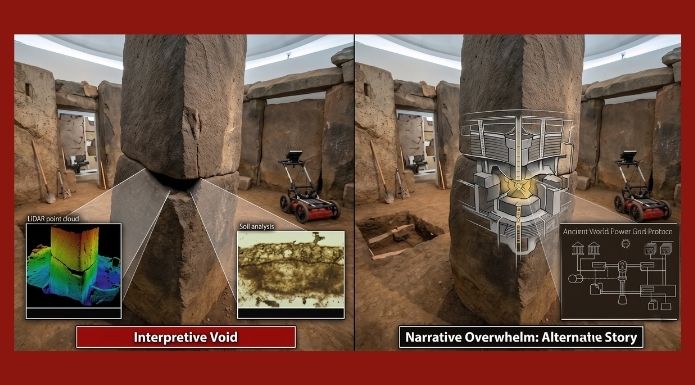
The Interpretive Void
Archaeology is a historical discipline that uses scientific techniques like carbon dating, LiDAR, and soil analysis. But the results of those techniques don’t speak for themselves. They require interpretation.
When a “hard” scientist like Neil deGrasse Tyson says he just “wants to measure things,” he’s missing the point that archaeology teaches us. You can measure a stone block to the millimeter, and even find out how old it is, but the measurements won’t tell you why it was placed there or what the people who moved it believed. That’s a game of induction, speculation, and narrative. It requires a lot of similar stones, left by similar people in similar ways, to become a narrative you can count on as being close to the truth.
An Open Invitation for Charlatans
Because archaeology relies so heavily on interpretation, it creates massive gaps in our understanding of the past. In a healthy discipline, those gaps are a call for more research. But archaeology has a habit of becoming a “closed circle.” I left the study of archaeology when I realized the field was often more about social dominance than objective truth. If you challenge the giants of the discipline, you aren’t met with a scientific counter-argument; you’re met with a defensive crouch. And, in fact, Hancock claims just that, that the giants of the field are close-minded. Ironically, he’s not incorrect. they’re too busy protecting their field than projecting their ideas.
This “protecting rather than projecting” stance is an open invitation for actors like Graham Hancock. When archaeologists act like a priesthood guarding a sacred timeline, it allows Hancock to frame himself as the “open-minded outsider.” He isn’t just a pseudoscientist, he’s a storyteller filling a void that archaeologists are too busy gatekeeping to address, a systemic failure laid bare when you audit the internal, jargon-heavy Archaeology Turf War: Flag-Planting vs. Science Communication that consumes the field’s primary literature.
In fact, the Society For American Archaeology wrote a letter to Netflix pleading with them to take Graham Hancock off the air instead of getting out there and teaching people. We have to ask: Is Archaeology as a field so fragile that it’s only reaction is to go into a defensive crouch and try to silence an opponent because they can’t win the argument in the public sphere?
It would be difficult to stop the momentum of a charlatan like Graham, with so many books and his own documentary series on Netflix. But whining about it is hardly the winning reaction. Many experts in the field, as Skepchick points out, have debunked Hancock. However, this defensive posture is more of the same from a discipline that loves to correct the thoughts of others rather than shape them. If a ScreenLab analysis spent all its time merely reacting to charlatans instead of advancing entirely new frameworks and arguments, it wouldn’t be analysis at all, it would just be noise.
The “Priesthood” Problem
Archaeology often functions less like a laboratory and more like a priesthood. Because the evidence is fragmentary, authority is derived from Status rather than Replication. When you challenge the “Giants” of the field, you aren’t just questioning their data; you’re questioning the social hierarchy of the discipline.
This is why Hancock is so successful. He frames the archaeologists’ defensive behavior as a conspiracy of silence. And while his “Lost Civilization” is a fantasy, his critique of the field’s stodginess is, ironically, quite accurate. they’re so busy protecting their sacred timeline that they’ve forgotten how to actually communicate with the public. They’ve left a vacuum, and charlatans are simply the ones filling it. Lucky for your friendly ScreenLab analyst, I left the field before I could be caught up in this old boys club.
The “Documentary” Fallacy: Non-Fiction as Narrative
The anger directed at Netflix for hosting Ancient Apocalypse often boils down to a single, frustrated sentence: “Netflix plays fast and loose with the documentary category.” This is the exact same misconception we see in archaeology. Just as people confuse “measurement” with “science,” they confuse “Documentary” with “Truth.” We tend to treat the documentary section of a streaming service as a sanctuary of perfection, a “Truth Section” where every claim is a verified fact. In reality, a documentary is simply the non-fiction wing of the entertainment industry.
“Non-fiction” does not mean “objective reality”; it means “creative interpretation of data.” There is no barrier to entry here. Anyone with a camera can make a documentary and success often comes down to better editing and production. Netflix’s goal isn’t to educate the public on the stratigraphic layers of a dig site; it’s to keep them streaming. In the world of mass media, a well-told story, even one built on the hollow foundation of a charlatan, will always outperform a 50-minute academic take-down. If we’re waiting for a streaming giant to be the gatekeeper of scientific integrity, we’re waiting in vain.
Further Reading
- Why the Roanoke Colony Mystery Isn’t Actually “Solved”
- Brand Name Psychology: The Linguistic Branding Myth
- YouTube Inspiration Tool: The Algorithmic Slop Myth