In the world of the sci-fi film and television, DNA is often treated like a dynamic word document, something you can “Find and Replace” in real-time to turn a Starfleet officer into a lizard or an Air Force Colonel into a caveman. But biology doesn’t have an “Undo” (Ctrl+Z) function. In the real world, when you rewrite the blueprints of a standing building, the building doesn’t rearrange its own bricks; it usually just collapses. Before we dissect the “Miracle Cures,” let’s look at our three primary specimens.
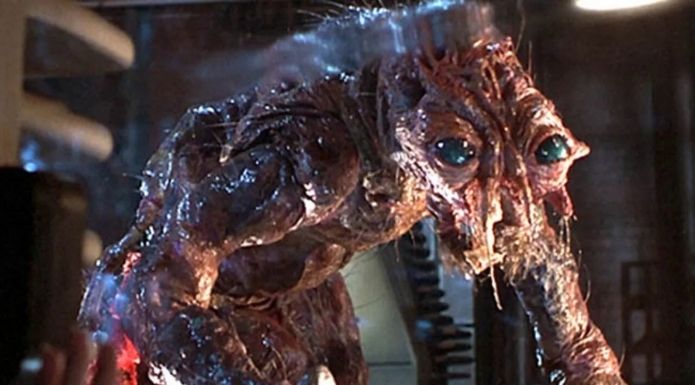
Specimen A: The “Brundlefly” (The Fly, 1986)
Let’s be clear: Jeff Goldblum occupies space with Nic Cage in my heart. He has a “Get Out of Jail Free” card, but it’s a different deck than the one Cage plays with. While Cage gets his pass for being a glorious, over-the-top force of nature, Goldblum earns his through sheer, quirky brilliance. In The Fly, he delivers a powerhouse performance that manages to stay “Goldblum-esque” even as he’s losing his humanity.
More importantly for the report, The Fly is the rare specimen that actually gets the Biological Horror right. Seth Brundle doesn’t just “morph” into a fly; he undergoes a necrotic, additive nightmare. Parts fall off because they’re no longer being maintained by his changing biology. It’s messy, it’s painful, and it’s the only time we’ve seen “de-evolution” treat the human body with biological respect.
The Medicine Cabinet vs. The Hypospray
The most striking difference between a “Hard Biology” horror film and a “Soft Science” TV show is how they handle Biological Waste. In the real world, if you grow something new, the old stuff doesn’t just evaporate.
Seth Brundle’s Jar: The Reality of Sloughing
In The Fly, Seth Brundle realizes early on that his transformation is additive, his fly DNA is building a new structure inside and over his human one. This leads to the “Medicine Cabinet” scene, which is perhaps the most biologically accurate moment in the film.
- The Science: As the fly physiology takes over, it stops providing nutrients and blood flow to “redundant” human structures like ears, teeth, and fingernails.
- The Result: These parts don’t “morph”; they undergo Ischemic Necrosis. They die and fall off. Brundle has to physically collect his discarded human parts in a jar because his body is literally throwing them away.
The Practical Magic of Rot: In reality, a “fly transformation” would be infinitely more gross, stinky, and rotten than what we see on screen. However, the filmmakers were limited by the technology of the time, massive latex masks and complex mechanical puppets. There are fascinating behind-the-scenes accounts of the difficulty of filming some of the transformation scenes.
The Star Trek “Fade”: The Magic of the Undo Button
Contrast this with the “Genesis” virus in Star Trek: TNG. When Captain Picard and Dr. Crusher find a “cure,” the crew doesn’t wake up in a pool of discarded lizard scales and necrotic skin.
- The Logic: The show implies that DNA is a “live-editing” software that can tell a cell to simply stop being a scale and start being skin again.
- The Biology Failure: This ignores Cellular Differentiation. Once a cell has committed to being a specialized structure (like a bone or a scale), you can’t just “toggle” it back without killing the cell and growing a new one. In the TNG version of reality, the biological mass just… disappears.
The xkcd “What If?” DNA erasure scenario is a biological fantasy. Discover why suddenly losing all your DNA causes instant electrochemical shock, not a slow decline. Read the full audit: The “Information File” Fallacy: Why DNA Erasure Means Instant Death
The Metabolic Debt: Why the “Cure” is a Death Sentence
The reality of such a “DNA transformation” supposing it were possible, would be no coming back. Even supposing a genius doctor could stop the process and then “reverse” it, the massive Metabolic Debt would be a certain death sentence. Biology is essentially a high-stakes construction project, and in shows like Stargate (The Broca Divide) or Star Trek TNG (Genesis), the crew is renovating the entire building without a budget or a trash crew.
1. The Energy Crisis
To grow a caveman’s thick brow ridge or a set of reptilian scales in 48 hours would require a staggering amount of cellular energy (ATP). We’re talking about a metabolic surge so intense it would likely raise the character’s body temperature to lethal levels, effectively cooking them from the inside out just to fuel the “re-evolution.”
2. The “Gravel Kidney” Problem
But the real fail happens during the “Cure.” When Dr. Fraiser or Dr. Crusher injects that miracle hypospray or syringe of antihistamine, and the bone density “vanishes” by the next scene, they’re creating a biological catastrophe.
- The Science: For that solid bone to disappear, the body has to engage in hyper-accelerated Osteoclast activity (the cells that “eat” bone).
- The Waste: That dissolved bone (calcium and phosphorus) doesn’t just vanish into the ether; it is dumped directly into the bloodstream.
In a real-world “Undo” scenario, the character wouldn’t wake up feeling refreshed. They would wake up in the middle of a massive Hypercalcemic Crisis. Their blood would essentially turn into a slurry of minerals, and their kidneys would be instantly shredded by “caveman bone” gravel.
Scientific Verdict: The “Miracle Cure” is biologically more violent than the disease. By the time the credits roll, our heroes should be in the ICU facing total organ failure from the sheer volume of biological trash their bodies are trying to process in a single afternoon.
The “Reassertion” Myth: Why Your DNA Doesn’t Have a Memory
The final, and perhaps most absurd, layer of this trope is the language writers use to describe the recovery. They often claim the “original DNA is reasserting itself” or “taking back control.”
The Expression Fact
DNA isn’t a ghost in the machine waiting to reclaim its throne. It is a blueprint. Once a virus or parasite inserts new segments and those cells begin expressing that DNA, turning skin into scales or bone into ridges, the “human” instructions for that specific area have been overwritten or ignored.
- The Permanent Expression: If a cell is currently programmed to be a reptile scale, it doesn’t “remember” it used to be a human pore. It just continues being a scale.
- The Stem Cell Paradox: To “revert” a lizard-man back into a bridge officer, you would have to trigger a total cellular dedifferentiation, essentially turning every cell in the body back into a blank-slate stem cell. At that point, you aren’t “curing” a person; you are liquefying them into a biological soup and trying to 3D-print a human from scratch. You wouldn’t get your Captain back; you’d get a very confused, 180lb infant, at most.
The Final Screen Lab Verdict
The “Miracle of Reassertion” is the ultimate Screen Lab violation. In reality, even if you miraculously “stopped” the virus, you wouldn’t revert. If you could still think and behave as human, then you would simply be a human with permanent, non-functioning lizard parts and a skull shape that no longer fits your brain.
There is no “Undo” button in biology. There is only the “New Normal,” and in the case of Star Trek or Stargate, that normal involves a lot of permanent, primitive bone structure and a very long, very painful road to a surgical center that probably doesn’t exist. But, I’m sure glad O’Neil went back to looking like normal again and stopped all that screeching!