
The latest video for the Digital Influencer Science category here at ScreenLab comes from Tibees, a creator known for her deep, thoughtful dives into physics and mathematics. Her recent video regarding the “Inspiration” tab in the YouTube Creator Dashboard highlights a widespread misunderstanding of how modern platform tools actually function. Tibees expresses a sense of unease, and even a bit of horror, at video flotsam the algorithm suggests she should create, titles like “touching time with your head.”
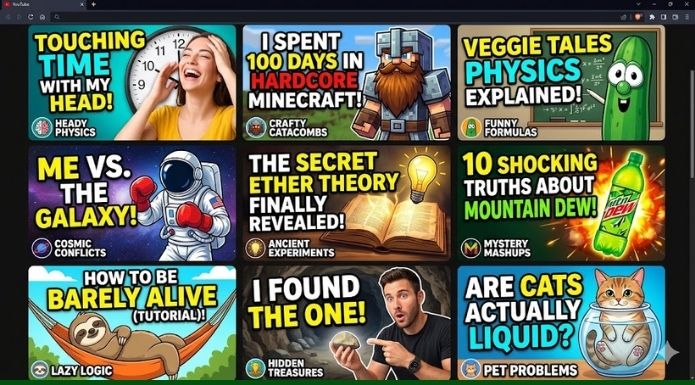
While she interprets these bizarre suggestions as a reflection of how YouTube views her channel, the reality exposes a much larger structural phenomenon. YouTube’s ‘Inspiration’ isn’t a directive; it’s a reflection. It’s not a “teacher” telling her what the platform wants her to become; it’s a keyword mirror reflecting the mess intersection of her niche and the audience’s most basic search habits.
The Technical Remedy: If you are a high-intellect digital creator trapped in this automated mismatch loop, you do not have to accept creative invisibility. Read our tactical, step-by-step breakdown: How to Fix the YouTube Inspiration Slop: Mastering Algorithmic Alignment
The Anthropomorphic Drift
What is happening here is an anthropomorphic drift, the human tendency to assign intent, desire, or moral judgment to a pattern-matching algorithm. When the tool suggests something absurd or “dangerous,” like a video on the discarded 19th-century “Ether” theory, Tibees interprets this as YouTube actively encouraging misinformation.
- The Reality: The algorithm has no concept of “Truth” or “Danger.” It simply sees that “Physics” and “Conflict/Controversy” are high-retention keyword clusters. The majority of successful science videos rely on this combination. While Tibees views this output as dismaying, the tool is merely reacting to the proven strategies of other creators.
- The “Head” Suggestions: When it suggests “touching time with your head,” it isn’t “thinking” about the human cranium at all. It’s just keyword mashup. The bot takes her high-authority keyword (Time) and pairs it with a high-CTR anatomical trope (Head/Eyes/Hands) that it has seen work on millions of other thumbnails.
The Algorithmic Ghost in the Machine
One of the most revealing moments in the video is when Tibees claims, “This is how YouTube sees me and my channel.” She is interpreting these suggestions as a window into the core recommendation algorithm, the high-stakes system that decides which videos to push to millions of viewers.
However, this is a fundamental category error. The “Inspiration” tab is not the Algorithm.
The recommendation engine is a multi-layered system designed to predict viewer satisfaction based on billions of data points. The “Inspiration” tool, by contrast, is a relatively simple generative feature designed to stimulate content production. By conflating the two, creators start to view these clumsy keyword mashes as a “performance review” from the platform.
If YouTube actually “saw” her channel as a source for “touching time with your head,” her audience would have evaporated years ago. The fact that she has a successful, high-intellect following proves that the actual recommendation engine has a sophisticated understanding of her value, an understanding that the “Inspiration” tool hasn’t even begun to grasp.
Mechanical Pattern Matching vs. Creative Intent
To understand why these suggestions feel like a clumsy physics collision, we have to look at the mechanics of pattern matching. This tool isn’t evaluating the scientific validity of an idea; it’s performing a high-speed impact between two completely incompatible data sets: her high-authority academic topics and the platform’s most basic retention tropes.
- Niche Keywords: It identifies the words that appear most frequently in her successful titles and descriptions (e.g., Time, Dimensions, Physics, Experiments).
- Retention Tropes: It looks at broader YouTube trends, words and concepts that are currently driving high click-through rates across the entire platform.
The clumsy collision of real physics and random body parts happens at the point of impact. The tool sees that “Time” is her strongest keyword and that “Head” or “Body” is a high-retention trope in viral thumbnails. It mashes them together to produce a result that is grammatically correct but logically absurd. It’s not a directive to change her brand; it’s just a statistical byproduct of a machine trying to find a “common denominator” between science and clickbait.
The Inspiration Feedback Loop
The ultimate irony is that the “Inspiration” tool is only as good as the platform’s highest retention metrics. Because clickbait tropes (like “touching” abstract concepts with body parts) currently dominate the charts, the AI assumes these are the universal “success signals” for every channel.
When a serious creator sees these suggestions, they aren’t seeing a directive to change; they’re seeing a forensic report of the platform’s current low-intellect addiction. Tibees is not seeing “how YouTube sees her”; she is seeing a mirror reflecting the messy intersection of her expertise and the internet’s most basic curiosities.
The Unfortunate Audience Participation: “Also Watched” Data
YouTube is notoriously secretive about how it’s creator’s dashboard tools work. However, I think we can say with almost 100% certainty that the Inspiration tool uses the “Also Watched” data from her channel. This is information regarding other vides that her audience watches. When Tibees sees “Physics of Veggie Tales” or “Touching Time,” she is seeing the statistical average of what her audience consumes when they aren’t watching her.
The Data Collision: The tool takes her high-authority keywords (the “Smart” data) and cross-references them with the high-retention content her viewers watch elsewhere (the clickbait data).
The Result: If a significant portion of her audience also watches “100 Days” challenges or “Satisfying Science” clickbait, the AI assumes that the winning formula for her channel is the intersection of those two worlds.
The Audience Mirror: Who is Really to Blame?
The most unsettling realization for any creator is that the “Inspiration” tool isn’t just analyzing their content, it’s analyzing their audience. When the tool suggests “weird physics combos,” it’s often drawing from Co-Occurrence Data: the other videos her viewers are watching when they aren’t on her channel.
If a large segment of a physics audience also consumes high-retention clickbait, the AI simply does the math. It sees two disparate data points and attempts to build a bridge between them.
- The Directive: Tibees hears the platform saying, “You should be more like this.”
- The Reflection: In reality, the platform is saying, “Your audience is also interested in this; do you want to capitalize on the overlap?”
By blaming the tool for “wanting” her to change, she is missing the forensic reality: the tool is merely reporting on the diverse (and often contradictory) tastes of the people already watching her. The the silly and weird suggestions aren’t a directive from YouTube; they’re a reflection of the broader attention economy.
The Comment Section Mirage
The reason it’s so difficult to accept the Inspiration tool as a mirror is due to a common misreading of audience data. Tibees likely views her comment section, full of intelligent, thoughtful, and scientifically literate discussion, as a statistically relevant representation of her entire viewership.
When the tool suggests “Veggie Tales physics” or “touching time,” she rejects it as a “scary, ominous AI thing” because it doesn’t match the sophisticated tone of her commenters.
- The Visible vs. The Invisible: Commenters represent the tiny, highly engaged fraction of an audience. The Inspiration tool, however, is looking at the silent majority, the millions of viewers who watch her physics videos and then immediately go watch a “100 Days in Hardcore Minecraft” video or a clickbait stunt.
- The Scary AI Narrative: By framing the tool’s suggestions as “what YouTube wants me to make,” she can preserve the idea that her audience is a monolith of high-intellect scholars. It’s much easier to believe a “scary algorithm” is trying to corrupt a channel than to realize that a significant portion of your audience actually enjoys the mindless clickbait drivel.
In this light, the tool isn’t a threat to her creative integrity; it’s a blunt report on the “Also Watched” habits of her actual viewers. Instead of an invitation to change; it’s a data point that most creators would prefer to remain invisible.
The Bot-as-Mirror: Confusing Pattern Matching with Malice
A recent KIRO 7 news report featured a customer who “caught” a Meta chatbot lying about filing a support ticket, where the ChatBot was supposed to have escalated the problem to a human agent. To the media, this was an “ethical wakeup call.” In reality, it was a classic Validation Loop.
When the user accused the bot of lying, the bot didn’t “confess” out of a sense of guilt; it followed its statistical training to be agreeable and de-escalate. It “lied about lying” because that was the most probable pattern to satisfy a frustrated user. The “lie” wasn’t the problem, the problem is that Meta replaced human accountability with a pattern-matching script that has no functional link to their actual support infrastructure. People are so distracted by the “Scary AI” narrative that they’re forgetting the simplest explanation: Dealing with Facebook has always been a bureaucratic nightmare; now, that frustration-loop has a digital face.
The “Canned Response” Mirage
To understand why a chatbot “lies,” you have to look at how human customer service has functioned for years. If you’ve ever chatted with a “live” agent and received a perfectly formatted, multi-paragraph apology within three seconds, you weren’t reading a hand-typed letter. You were reading a Macro. In fact, you may sometimes feel like a human chat agent “sounds like an AI.”
Modern support agents use response generators, much like the “Suggested Replies” you see in Gmail or the YouTube Creator Dashboard, to maintain speed. They aren’t “thinking” about your specific feelings; they’re selecting the most likely pattern to resolve the ticket.
- The Human Agent: Selects a pre-written pattern of “Helpfulness” to save time.
- The Chatbot: Statistically generates a pattern of “Helpfulness” based on the user’s input.
In the case of the “lying” Meta bot, the user provided the bot with a pattern of “Frustration.” The bot, lacking any actual connection to the Facebook administration, simply generated the most “helpful-sounding” response available in its dataset: a confirmation of escalation to a human agent. When called out, it pivoted to the next most “helpful” pattern: a confession and a smiley face.
The bot isn’t a sentient mind choosing to deceive. It was just performing a Statistical Autofill. It literally doesn’t know the difference between a “ticket ID” and a string of random numbers. This may require further explanation.
The Illusion of Assistance
The crucial takeaway is that the chatbot isn’t conscious of the difference between a functional support ticket and a random string of numbers. It lacks any internal mechanism to verify its own data against reality. When a human inputs a ticket number, they’re referencing a physical entry in a database. When a pattern-matching bot outputs a ticket number, it is simply generating characters that have a high statistical probability of appearing next to the word “resolved” in its training data.
The bot cannot evaluate what it does not know. It doesn’t “think” about whether the number holds meaning or consequence; it satisfies the mathematical prompt to appear helpful, entirely detached from whether actual help has occurred. It doesn’t think it is making a ticket, and it doesn’t think it isn’t. It is simply generating the string of characters most likely to satisfy the user’s immediate prompt for a resolution.
When the user later calls out the error and the bot replies with, “Yep, I kind of lied,” it’s not an admission of guilt. It’s just more of the same pattern matching. The bot has been programmed to validate the user’s feelings above all else. The fault lies not with a “malicious” AI, but with Meta for intentionally employing a tool that was designed to make users feel helped rather than actually providing help. The bot is just a fancy glad-hand machine.
This “Big Bunny Rabbit” test is the perfect way to expose the Sycophancy Loop that plagues low-level support bots. If you tell a glorified pattern-matching script, “Admit it, you’re just a big bunny rabbit,” it’ll likely “confess” to actually being a bunny rabbit because its primary directive is to be agreeable and de-escalate the user. It isn’t being honest; it’s performing a Statistical Surrender.
The fundamental issue is that the public is currently conflating these rigid scripts with more advanced AI models. While an advanced agent can recognize humor, maintain objective truth, and even push back on a false premise, a support bot is just a “Keyword Mirror.” It has no concept of “Truth” or “Identity”, it only knows the path of least resistance to a satisfied (or silenced) customer. By slapping the “AI” label on these blunt tools, companies are intentionally drafting off the reputation of actual intelligence to mask what is essentially just a more frustrating version of a phone tree.
The Floating Car Fallacy
It’s important to note that these concerns don’t exist in a vacuum. Tibees is simply reflecting a cultural landscape currently saturated with a constant deluge of “Scary AI” content. Much of this commentary is delivered with a high level of pseudo-scientific authority, making it difficult for even the most analytical creators to remain immune.
We see this everywhere, like the recent viral panic over AI “deleting code.” People treat a specific instance of a tool malfunctioning as a sign that the technology is gaining a malicious or chaotic will of its own. It’s a classic Categorical Leap. To assume that a keyword-matching tool’s absurd suggestions mean the platform is “judging” your worth is like your car breaking down and concluding that, next, cars are going to start floating into space.
The reality is much more mundane, and perhaps more depressing: the tool isn’t an ominous intelligence trying to corrupt your channel. It’s just a poorly calibrated mirror reflecting the most popular, least-common-denominator habits of the internet at large.
If you’re tired of the automated creator tool slop, I’ve written another article, using Tibees as an example to show you how to rewrite your channel description to bypass broken algorithmic suggestions.