
The latest video from the “History” wing of YouTube, a video titled “Scientists Finally Solved The Roanoke Colony Mystery” by the channel First Humans, is a fascinating study in the Automated Authority Costume. Delivered by a synthetic, “sleepy” narrator whose tone suggests he is reading the final scrolls of human knowledge, the video attempts to close one of archaeology’s greatest cold cases using a collection of logical leaps that are nothing short of comical.
The Evasion Loop: Identifying by Absence
The “Common Sense” Smokescreen: Before talking about Site X ( near Salmon Creek in Bertie County, North Carolina), the narrator begins by attempting to lend an air of professional expertise by stating, “When you’re looking for people who’ve been missing for 400 years, you don’t look for wooden forts; wood rots. You look for what they threw away.” This is an evasion tactic that bypasses the most critical question in archaeology: How did you know where to dig? By framing discovery as a simple matter of finding “what they threw away,” he ignores the complex science of site surveys and remote sensing. It creates the illusion that these artifacts just appeared out of the blue to validate his theory, rather than being part of a nuanced, often contradictory, archaeological landscape.
The video then portrays negative evidence as “definitive proof.” It cites the lack of 17th-century clay pipes at specific inland sites on Roanoke as definitive proof that the residents were the 1587 “Lost” colonists from Roanoke. The narration states that since the Jamestown settlers were so fond of clay pipes, this could not have been them. It therefore must be the Roanoke colonists.
- The Reality: While archaeologists are often guilty of making inferences from a lack of evidence, or what is not found, citing a lack of post-1607 artifacts only tells you the site isn’t a later Jamestown-era settlement. It does not, and cannot, positively identify the 1587 settlers.
- The Structural Evasion: The video treats a chronological marker as an identification badge, a classic maneuver used to turn a “maybe” into a “Solved!” thumbnail. The lack of clay pipes only shows that some other people settled at these sites. This may have been a different project and not the Roanoke colonists.
- The Locational Monopoly: The video operates on the absurd premise that the Lost Colony was the only group of Europeans to ever step foot in this region of North Carolina before 1607.
- The Ghost Ships: It completely ignores the reality of the 16th century: shipwrecks, Spanish explorers, French privateers, and undocumented English trading ventures.
- The Native Trade Network: It fails to account for the sophisticated trade networks of the Algonquian and Tuscarora peoples. A piece of European pottery on Hatteras (more on this later) doesn’t mean a colonist lived there; it means a Native trader likely acquired a high-value item and moved it.
[Bunker Note: The Universal Pattern] This video is a digital evolution of the same “Credentialing Shield” we audited in our deep dive on Neil deGrasse Tyson. Whether it’s an AI voice or a celebrity scientist, the tactics remain the same: using a vague shield of authority to bypass the messy mechanics of actual evidence. Read the Audit: The Authority Costume: Neil deGrasse Tyson and Historical Fusion
The Borderware Evasion
Perhaps even more comical than using a lack of clay pipes to prove the lost Roanoke settlers must have moved inland, is claiming a certain type of pottery found at Site X is evidence of anything but “English people.” This greenish pottery (with oxide green glazes) is called Surrey-Hampshire Borderware.
- The “IKEA” of the 1500s: Borderware was produced from the 14th through the 19th centuries. Finding it at Site X doesn’t “identify” the Roanoke colonists any more than finding a generic white ceramic mug in a ruin identifies a specific coffee shop chain.
- The Temporal Confusion: The narrator uses the presence of Borderware to anchor the site to the 16th century, but then performs a Logical Leap to claim it must be the Lost Colony.
- The Missing Counter-Narrative: He completely ignores that Borderware is found in massive quantities at Jamestown (post-1607). While he uses the absence of clay pipes to rule out Jamestown, he uses the presence of Borderware to “prove” Roanoke, ignoring that both sites would have had the pottery, but only one is “famous” enough to drive YouTube clicks.
The narrator claims that ‘wood rots, but trash stays.’ True. But in the case of Borderware, the trash is anonymous. Using a mass-produced English potshard to identify a specific group of 115 missing people is like finding a generic AA battery in the woods and claiming it proves the existence of a specific lost flashlight.
The Hatteras Cohabitation: Trade vs. Assimilation
The video moves next to Hatteras Island, claiming that finding 16th-century English artifacts in Native village sites “proves” the colonists fractured and assimilated with the Croatoan people. This is more of the same as above: A Locational Monopoly maneuver, starting with the very name “Croatoan” itself.
- The Name as a Map, Not a Curse: Before it was a shorthand for “supernatural disappearance” in the works of Stephen King (It, Storm of the Century) or a demonic virus in Supernatural, “Croatoan” was simply a geographic and tribal designation. It was the name of the island (now Hatteras) and the Algonquian-speaking people who inhabited it.
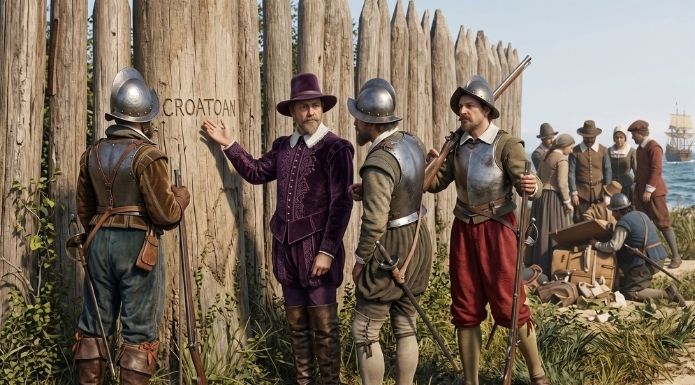
- The Croatoan Sign: When John White found the word carved into a post, it is widely believed that instead of a cryptic warning it was a pre-arranged signal indicating the colonists had moved to that specific island. However, there is no definitive evidence that they actually did.
- Trade vs. Identity: Finding a 16th-century ring or tool in a Croatoan village is definitive evidence of a trade network, not necessarily a family tree. European goods were high-value status symbols that moved through sophisticated indigenous trade routes long before (and after) 1587.
- Narrative Convenience: The narrator interprets “English object in Native hands” as “English person in Native bed” because it fits the “Solved” mystery trope. It ignores the far more likely archaeological reality: salvage from shipwrecks, trade for food, or items passed through multiple hands across the Outer Banks.
The Monopoly of Failure: Why Roanoke?
Perhaps the most damning observation regarding this video is why the channel chose Roanoke at all. If you search for “Lost Colony,” the digital landscape makes it appear as though Roanoke was a singular, anomalous event in human history.
- The Selection Bias: In reality, the 16th and 17th centuries were a graveyard of European ambition. From the Spanish failure at San Miguel de Gualdape in 1526 to the French disaster on Saint Croix Island, North America is littered with “lost” settlements.
- Famous for Fiction: Roanoke is famous because of fiction, not because archaeologists are uniquely agonizing over it. Because it was the first English attempt, and because the word “Croatoan” was successfully rebranded as a supernatural trope by writers like Stephen King, it has a market value that other failed colonies lack.
- The Content Farm Logic: A video titled “Scientists Finally Solve the Failure of the Popham Colony” doesn’t generate millions of views. By centering the audit on Roanoke, the narrator is leaning on Narrative Convenience rather than historical significance. They aren’t following the evidence; they’re following the SEO.
The Brown Identity: A DNA Comedy
Finally, we reach the video’s “Smoking Gun”, the DNA of a modern participant named Mr. Brown. According to the sleepy narrator, because this man has English DNA and the surname “Brown,” and because there were “Browns” on Roanoke, the mystery is solved.
If the archaeological evidence was sketchy, this DNA evidence is absurdist comedy. To appreciate it the sheer depth of the comedy, you have to look at the math:
- The “Smith” Irony: In the 16th century, “Brown” was an extremely common name, not a geographical ID linking someone to North Carolina settlers. Claiming this is a breakthrough is as scientifically rigorous as finding a man named “Smith” with English DNA and claiming it proves he is the specific heir to every Smith in colonial history.
- The DNA Ghost: To have a “match,” you need two things to compare. We have the modern Mr. Brown, but we have zero DNA from the 1587 colonists. Without a control specimen, either 16th-century remains or a confirmed English lineage that stayed in Britain, a DNA test only proves that Mr. Brown is of English descent.
- The Logical Loop: We are being asked to believe that a generic genetic marker for “Englishness” is a pinpoint strike for a specific boatload of people from 450 years ago.
Consider this a ScreenLab Public Service Announcement: If your surname is White, Dare, or Brown, maintain vigilance and where your Sunday best. According to ‘First Humans’ logic, you are a walking archaeological breakthrough. Expect a documentary crew to arrive shortly to interview you about your missing colonial relatives.
The Authority of the Void
The ultimate “ScreenLab” irony can be found in the video’s own description. To bolster its “Solved” claim, it links to a University of North Carolina Press page for the book Excavating the Lost Colony Mystery.
- The Digital 404: When you click the link, you don’t get a data-rich report; you get a site header and a blank page. It’s a perfect metaphor for the entire video: a high-prestige label (UNC Press) draped over an absolute vacuum of information.
- The Peer-Review Problem: A book published directly for the public is essentially the lowest form of scientific evidence. Why is this being marketed as a “solution” in a hardcover book rather than in a peer-reviewed journal like Southeastern Archaeology or The Journal of Island and Coastal Archaeology?
- The Reason: Because a book allows for “Narrative Convenience.” You can link common surnames like “Brown” and mass-produced “Borderware” pottery into a satisfying story without a peer-reviewer asking for a DNA control group or a 16th-century stratigraphy report.
The ScreenLab is sorry to have to report the obvious conclusion: The mystery of the Lost Colony of Roanoke has not been solved. However, if the ultimate answer is that the colonists essentially wandered off, well, what a let down. Ironically, if this were the case, a video of around three minutes in duration would be sufficient to explain it.
Think about the boredom tax such video creators have to avoid. If the truth really is that a small group of desperate people moved 50 miles inland to find food and eventually blended into the local population over several generations, it’s a quiet, human story of survival. But you can’t sell “quiet survival” to a mass audience looking for a supernatural fix. To get those eight-plus minutes of watch time, they have to inflate “they moved” into “SCIENTISTS FINALLY SOLVE THE UNSOLVABLE.”