
Have you ever wondered what the zombie actors in The Walking Dead were actually chewing on while tearing into an unfortunate survivor on screen? In a pure narrative vacuum, the audience is meant to experience visceral horror and cold depravity. But if you step just three inches outside the camera frame, the terrifying illusion immediately dissolves into a sticky, low-tech culinary operation.
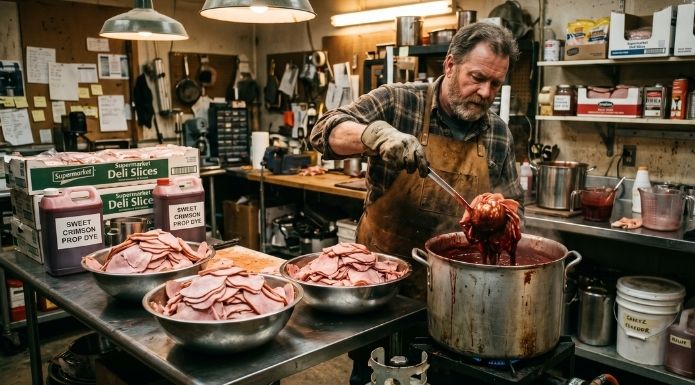
To be clear, the background cast wasn’t tearing through a full structural anatomy made of meat. The highly visible, stringy practical elements like fake intestines and organs were sculpted out of standard non-edible latex and silicone. But for scenes requiring the actors to actually place a substance in their mouths and mimic active consumption, the special effects department needed an edible baseline. In the early seasons of the show, that universal surrogate was industrial-sized batches of deli ham soaked in barbecue sauce. On paper, it sounds like a decent catering perk. In practice, it’s a stomach-churning nightmare.
Imagine sitting on a soundstage for a grueling twelve-hour shooting day, take after take, constantly stuffing your face with room-temperature, barbecue-drenched deli meat under hot studio lights. Nobody on earth wants to eat that much ham. By hour eight, the romantic magic of Hollywood vanishes, replaced by a profound, existential dread of cold cuts. It’s safe to assume a significant portion of that background cast couldn’t look at a holiday dinner table for years without experiencing severe post-apocalyptic flashbacks.
And the logistics only got weirder. As production scaled, the practical effects team encountered an unexpected problem: The high vinegar and sugar content in standard supermarket barbecue sauce was physically eating away at the actors’ heavy prosthetic zombie makeup over the course of the day.
The solution wasn’t a high-concept digital VFX layer but a menu change. The prop department swapped the recipe, forcing the background actors to spend the rest of the season ravenously consuming deli ham drenched in a specialized, non-acidic sweet crimson dye.
This is the hidden mechanical reality of cinema. The moment a script requires a character to consume something toxic, unpalatable, or physically hazardous, the entire production halts until an assistant prop master figures out how to cook a high-fidelity, digestible duplicate, even if it means creating a life-long ham phobia for the actors.
The Metabolism Evasion: While the practical effects department must transform into an industrial kitchen the moment a script forces an actor to swallow an environmental hazard or a piece of raw anatomy, commercial directors frequently default to a much lazier spatial hack. To completely bypass the multi-take continuity traps and congealed physics of real soundstage food, modern film sets routinely mandate a universal “no-eating” rule—turning high-end restaurant scenes into pristine displays of completely untouched food. Read the full audit: The Untouched Meal: Why Movie Characters Never Eat
The High-Fructose Hostage Crisis of Super Troopers
To fully understand why prop masters must treat edible substances with strict discipline, you only need to look at the infamous maple syrup chugging sequence in the 2001 indie comedy Super Troopers. Running on a shoestring budget and a deficit of seasoned crew, the production team made a potentially catastrophic logistical error: they forced the actors to chug real, unadulterated maple syrup for multiple takes.
The results were a physiological disaster. While the final theatrical cut of the film edited the sequence down to make it appear as though the characters only consumed a single bottle each, the reality of a multi-take film set required a staggering volume of ingestion. Director Jay Chandrasekhar (who played Thorny) chugged two and a half full bottles of syrup, while co-star Kevin Heffernan (Farva) downed over three. The concentrated surge triggered a metabolic crisis.
According to Chandrasekhar, the he and Heffernan spent lunch laying completely flat in the dark inside a production trailer, physically shaking for thirty minutes as their bodies went into shock. The massive sugar bombardment caused acute osmotic distress in their digestive tracts, resulting in a delayed but brutal gastrointestinal “cleansing” effect (aka diarrhea) that essentially paralyzed the cast and derailed the crew’s shooting schedule for the rest of the day. As Keven Heffernan pointed out to Chandrasekhar, “there’s a reason they include maple syrup in cleansing diets.”
Dilution and Density: The Chemistry of the Safe Chug
This is the exact crisis a professional prop master is hired to prevent. In a disciplined studio environment, an actor is never asked to consume high volumes of dense, raw ingredients. If the director demands a sequence where a character chugs syrup, the prop department completely bypasses the grocery aisle and engineers an elegant fluid illusion. They tint distilled water with specific drops of browning liquid or unsweetened black tea to match the exact light-refraction index of maple sap. If the camera requires a tight macro shot of the liquid sluggishly clinging to the glass as it’s tipped back, the water is lightly bound with non-toxic, food-grade vegetable glycerin to give it a heavy, slow-moving pour.
The result is a fluid that looks rich and dense on a 4K camera, but flows with the ease of pure tap water, allowing an actor to execute five takes without their metabolic system going into emergency lockdown. Furthermore, from a strict set-safety standpoint, volume is always the enemy. Even if a prop department supplies an actor with completely harmless, perfectly engineered prop water, a seasoned crew will never allow talent to down bottle after bottle in rapid succession across multiple takes without a mandatory break. Ingesting massive quantities of water too quickly can trigger acute hyponatremia, water intoxication, which dilutes blood-sodium levels to lethal thresholds.
When massive volume is non-negotiable for a single shot, the prop master must abandon the actual chugging entirely and rely on Frame Occlusion. A classic example is the famous two-liter soda-chugging sequence in Elf (2003). Will Ferrell wasn’t actually consuming an entire bottle of carbonated sugar water; the liquid was being siphoned down a thin, clear tube taped to the blind side of his face and fed directly out of the bottom of the camera frame. Likewise the copious amounts of maple syrup that Will Ferrell put on his food or drank straight from the bottle was definitely not maple syrup.
Super Troopers proved that a failure to respect the engineering of edible props turns your cast into a medical liability, but Elf showed that sometimes the best way to digest a prop is to make sure it never actually enters your body.
1. The Butcher’s Illusion (Edible Raw Meat and Poultry)
In a gritty crime procedural, a historical survival epic, or a monster movie, the script will occasionally demand that an actor ravenously consume raw animal tissue. While old Hollywood lore is full of unhinged method actors chewing on actual raw liver, modern union sets and multi-take continuity render real raw meat a biochemical hazard. Leave a plate of raw steak under 500-watt studio lights for four hours, and your lead actor is heading straight to the emergency room with salmonella before the director can even yell “wrap.”
To bypass the biohazard, prop masters have spent decades perfecting the art of fake butchery:
- The Raw Beef Substitute: When a character has to rip into a raw steak or a fresh heart, the industry standard relies heavily on canned peach halves or solid blocks of watermelon. The prop department marinates the fruit in a viscous mixture of red food coloring, unsweetened cranberry juice, and sweetened condensed milk. The fruit provides a fibrous, dense resistance when bitten, while the milk-and-juice slurry perfectly mimics the glistening, opaque look of coagulation on camera, all while tasting like a sweet tropical dessert.
- The Raw Chicken Conundrum: Raw poultry is arguably the most unappealing texture most people can imagine. If an actor has to handle or appear to bite into raw chicken breasts, prop masters often manufacture them out of sculpted marzipan or dense, unflavored gelatin molds tinted with a pale, sickeningly accurate mix of pink and yellow dyes. The rubbery, slick bounce of setting gelatin reads as flawlessly raw to a high-definition camera lens, saving the talent from a disastrous encounter with raw bird bacteria.
2. Graveyard Geophagy (Edible Dirt and Mud)
When an actor is dragged through a trench, buried alive, or forced to claw through soil with their teeth, using actual ground earth is an absolute non-starter. Real dirt is packed with bacteria, micro-organisms, and agricultural runoff that makes ingestion a severe legal liability for a production company.
To stage a convincing mouthful of topsoil, the prop department runs a specialized baking operation. “Edible dirt” is typically constructed by combining crushed Oreo cookies (minus the white cream filling), chocolate pudding mix, and Grape-Nuts cereal to establish varying granular densities that catch the light correctly on high-definition camera sensors. For wet mud, prop masters introduce chocolate syrup or corn-starch slurries, creating a viscous, high-contrast sludge that reads as filthy on camera but tastes like a bakery display case.
3. The Desert Mouthpiece (Edible Sand)
Characters surviving a desert trek frequently collapse into a dune, coughing up fine silica. Real sand contains quartz crystals and microscopic shards that can permanently lacerate an actor’s vocal tracts or destroy expensive dental work under pressure.
For dry sand that needs to safely fill an actor’s mouth, nose, or eyes, prop masters deploy sifted graham cracker dust, brown sugar, or powdered vanilla wafers. The mix must be carefully sifted to match the exact regional grain size of the shooting location, ensuring the talent can realistically choke on cue without triggering an actual respiratory emergency.
4. The Sticky Inversion (The Global Fluid Standard)
When it comes to environmental hazards like grave soil or desert sand, the prop department only resorts to a culinary recipe if the script explicitly demands the talent ingest it. Otherwise, they use actual, sanitized earth or silica. Fake blood, however, flips this entire operational logic on its head.
Whether a character is spitting it up during a boxing match or simply bleeding out on a battlefield, movie blood is almost always a food product by default. The undisputed backbone of practical cinematic gore is the legendary “Dick Smith Recipe”—named after the legendary special effects artist behind The Exorcist and The Godfather. The base of this global standard isn’t a complex chemical polymer; it’s plain, white Karo corn syrup. To transform this breakfast condiment into a convincing illusion of human trauma, prop masters deploy a highly specific structural matrix:
- The Standard Recipe: Corn syrup establishes the thick, viscous, organic flow of real blood. To get the color right under high-intensity studio lights, prop masters mix in red food coloring, balanced by a tiny splash of yellow (to prevent it from looking like bright pink candy) and a heavy dose of chocolate syrup or blue food dye (to darken the tone and mimic venous oxygen deprivation).
- The Non-Edible Additive: To make this sticky syrup usable on a practical set, prop departments almost always add a squirt of Dawn dish soap or photo detergent. The soap acts as a surfactant, breaking the surface tension so the syrup sheets realistically across skin instead of beading up like plastic oil, and critically, allowing the intense red dyes to wash out of expensive wardrobe pieces between takes.
- The Edible Adjustment: When the script dictates that an actor must cough up blood, have it pour from their mouth, or swallow it during a sequence, the recipe doesn’t change—the prop room simply executes a few crucial omissions and additions. The toxic dish soap is stripped out entirely, sacrificing wardrobe cleanup for talent safety. Because raw corn syrup tastes like a throat-coating sugar shock that can make an actor gag mid-delivery, prop masters mix in peppermint oil, cherry flavoring, or organic cornstarch slurries to make the concoction palatable enough to hold in the mouth for a three-minute dramatic close-up.
5. Alien Vitality (The Extraterrestrial Slime)
The culinary hustle doesn’t stop with human anatomy. The moment a sci-fi or fantasy script calls for an actor to be covered in alien residue, predatory saliva, or radioactive ooze, the prop room returns to the pantry.
The primary vehicle for Hollywood creature slime is Methylcellulose—a colorless, odorless powder that functions as a thickener in commercial salad dressings and fast-food milkshakes. When whipped with warm water, it creates a perfectly viscous, stringy, high-gloss slime that can be tinted with neon food dyes or glow-in-the-dark vitamin B12 solutions. Because it is completely non-toxic and structurally digestible, actors can be completely buried under tons of it (think the green slime of Ghostbusters or the dripping jaws of Alien) without risking a toxic chemical emergency on a union soundstage.
6. The Confectioner’s Violence (Sugar Glass to Modern Resins)
Of all the practical material substitutes on a movie set, breakaway glass is perhaps the most heavily romanticized by audiences, and the most tedious to actually manage. When an action sequence calls for a stunt performer to be thrown through a plate-glass storefront or struck over the head with a whiskey bottle, using actual silica glass is out of the question; it fractures into razor-sharp, microscopic shards that would shred an actor’s skin or eyes instantly. For decades, the standard industry solution was literal candy production.
To create classic “sugar glass,” the prop department set up a confectionery kitchen, boiling a precise ratio of water, granulated sugar, and corn syrup up to the “hard crack” stage, roughly 300°F (149°C). Once cooled in silicone molds, it hardened into a perfectly transparent, brittle sheet that mimicked the look of real glass flawlessly. Because it was 100% sugar, it was completely edible. If an actor took a breakaway bottle to the face and ended up with shards in their mouth, they could safely chew and swallow the prop without breaking character.
However, behind the high-velocity screen violence lay a logistical nightmare for the crew. Sugar glass is hygroscopic, meaning it aggressively absorbs moisture from the air. Leave a sugar-glass window sitting on a humid soundstage for more than a few hours, and it will begin to sweat, warp, turn sticky, and melt under the heat of the studio lights.
Because nobody wants to halt a massive production because the windows are melting, modern practical effects departments have largely abandoned sugar glass for anything other than scenes requiring explicit consumption.
Today, the global industry standard for breakaway props has transitioned to specialized pourable plastic resins, such as Piccolastic or brittle hydrocarbon polymers. These modern resins are entirely synthetic, completely immune to humidity, and can sit under blistering studio lights indefinitely without losing their structural integrity. When struck, they shatter into dull, lightweight, harmless fragments that perfectly mimic the kinetic snap of a real window pane without cutting the talent.