
The Cretaceous Convenience: Why It’s Always 66 Million BC
In the world of cinematic “Oops” moments, time machines are remarkably consistent. If a machine is “unreliable” or “accidental,” it never drops you in the Silurian period to look at some interesting moss. It ignores 180 million years of diverse dinosaur evolution, the Triassic and the Jurassic are apparently “flyover states” of time, and lands you squarely in the last two million years of the Cretaceous. Why? Because that’s where the Tyrannosaurus rex lives.
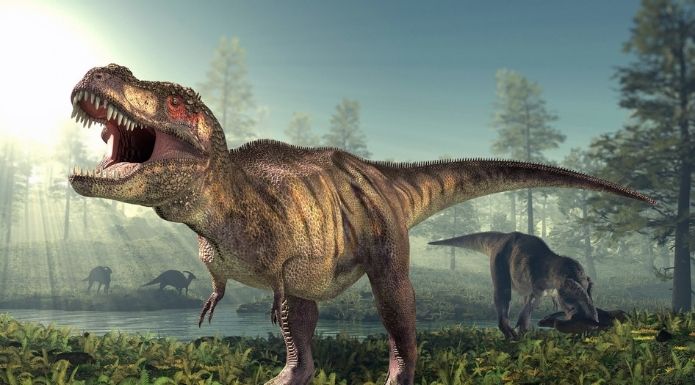
Take the characters in A Sound of Thunder. They aren’t just time travelers; they’re “Chronological Snipers” aiming for the exact window where they can shoot a dinosaur. Even in the film 65, which technically features an alien landing, the “accidental” arrival happens not just on Earth, but in the specific 1% of Earth’s history where they can be besieged by multiple rexes simultaneously, and just before the asteroid hits.
It’s as if the universe isn’t governed by entropy, but by a narrative magnet that pulls every traveler toward the most dangerous 0.001% of the timeline.
The Selection Bias (Jurassic Gatecrashing)
Sound of Thunder tries to make the scenario “plausible” and in so doing, just calls more attention to the unplausible nature of the trope. As if landing in a 2-million-year window wasn’t unlikely enough, the 2005 remake of A Sound of Thunder features an Allosaurus.
- The 75-Million-Year Error: The film is set in the Cretaceous, yet the Allosaurus is a Jurassic predator. It’s the chronological equivalent of going to a Civil War reenactment and being attacked by a Roman Centurion.
- The Path Paradox: The hunters are restricted to a floating path because “stepping on a mouse” could collapse the future. Yet, they’re there to kill a multi-ton apex predator that is supposedly seconds away from its “natural” death.
- The Natural Death Loophole: The “natural death” excuse is the ultimate Narrative Convenience. It allows the writers to have their cake (high-octane dino hunting) and eat it too (maintaining the “Butterfly Effect” stakes).
If you time-travel back to dino-time, your odds of encountering a T-Rex, or any dinosaur the moment you land are astronomically. Similarly, as a Medieval time traveler, your odds of encountering but a big nothing with lots of other nothing coming your way are quite low. Learn why you don’t always land in the middle of a battle, just in time to save the village from an evil tax collector with your future-knowledge: The Event-Density Fallacy: Medieval Time Travel & the Big Empty
Historical Audit: The Bradbury Precedent
It is worth noting that while the 2005 film is a disaster, the original 1952 short story by Ray Bradbury is the foundation of the entire genre.
- The Butterfly Effect: Bradbury’s story effectively popularized the concept that a single, microscopic change in the past, like stepping on a butterfly, could fundamentally alter the trajectory of human history.
- The Genre Catalyst: Before this, time travel was often about grand historical shifts. Bradbury made it about the terrifying fragility of the timeline, a theme that has since been adapted, parodied, and misused in everything from The Simpsons to The Butterfly Effect (2004).
While Bradbury’s butterfly gives us the narrative “rules” for temporal fragility, those rules still have to contend with the messy, indifferent reality of biological and ecological systems. Even if you manage to avoid stepping on a prehistoric insect, you still have to survive an ecosystem that, by all rights, shouldn’t be able to support the sheer density of monsters the movies insist on putting in your path.
The Trophic Overcrowding Paradox: Too Many Kings, Not Enough Kingdom
In cinema, the Cretaceous period looks like a crowded subway station, but biology demands a “No Vacancy” sign.
- The Territory Problem: An apex predator the size of a Tyrannosaurus rex requires a massive home range to find enough calories. If we accept the emerging theory that they may have hunted in small groups or pairs, the problem actually gets worse for time travelers. A group of multi-ton carnivores needs a significantly larger territory than a lone hunter. This makes the statistical probability of landing smack in the middle of a “T-Rex meeting” nearly zero.
- The Dino War Scenario: If multiple small groups of Rexes actually converged on a single spot (like a group of stranded humans), the result wouldn’t be a coordinated human-hunt. It would be an immediate, violent territorial dispute. The humans wouldn’t be the main course; they’d be the tiny, insignificant “nothings” scurrying around while the multi-ton titans settled who actually owned that patch of forest.
The Evolutionary Search Image: Why You Smell Like Danger, Not Dinner
Movies love the “bee-line” shot—a predator catching a scent from miles away and charging. But evolutionary biology suggests the opposite.
- The “Alien” Scent: A Tyrannosaurus is tuned to the smell of Triceratops and Hadrosaurs. A human, trailing the scent of laundry detergent, coffee, and synthetic fibers, is an olfactory enigma.
- Avoidance vs. Aggression: In the animal kingdom, “unknown” usually equals “potentially dangerous.” An apex predator survives by being a calculated risk-taker, not a reckless brawler. To a T-Rex, you’re a confusing, bony alien. Encountering a completely foreign smell and sight might just as easily trigger an avoidance response. Why risk an injury attacking a weird, bipedal alien when there’s a perfectly good (and recognizable) Edmontosaurus over the next hill?
The Bone and Skin Sandwich: A Caloric Insult
To top it off, even if a Rex did decide to experiment, the reward is a “bone and skin sandwich.” Compared to the massive fat deposits and muscle density of their usual prey, a human is a low-yield caloric disappointment.
The Realism Irony (Terra Nova & The CGI Distraction)
Audiences and critics often fall into a specific trap: they confuse visual fidelity with scientific plausibility.
- The CGI Smokescreen: Terra Nova was praised for its “realistic” dinosaurs, but the most unrealistic part of the show wasn’t the skin texture, it was the density.
- The “Nursery” Trope: The colony accidentally being built on a Pterosaur breeding ground is the ultimate “Cretaceous Convenience.” In a vast, empty world, the narrative forces a collision because “peaceful coexistence in a massive, empty forest” doesn’t make for good television.
- The Singular Focus on Esthetics: We’ve perfected the art of making a dinosaur look like it’s there, but we’ve completely ignored the probability of it actually being there.
The Mass-to-Space Ratio: Why the Cretaceous was “Empty”
The most glaring error in these films isn’t the CGI; it’s the population density.
- The Size vs. Population Inverse: Basic ecology tells us that as the average size of an animal increases, the population density must decrease. You can fit a thousand squirrels in a square mile, but you can barely fit a handful of multi-ton dinosaurs.
- The “Savannah” Comparison: Even on the modern African Savannah, which is significantly more “crowded” with life than the Cretaceous likely was, you can potentially trek for a full day without seeing a single predator.
- The Cinematic Jungle: In movies like 65 or 100 Million BC, the land is “teeming.” You can’t walk ten feet without tripping over a raptor or a T-Rex. In reality, a time traveler in the Cretaceous would likely spend days walking through a silent, empty forest, seeing nothing but oversized ferns and the occasional dragonfly.
The Stealth of the Apex (Avoidance over Aggression)
We often imagine that “landing near a predator” means an immediate chase, but even in the modern world, that’s rarely how nature works.
- The Lion Comparison: If you were to take a random walk through the African Savannah, you might technically pass within a few hundred yards of a pride of lions. In most cases, you would never even know they were there. Why? Because they heard you or smelled your “alien” scent long ago and simply hunkered down in the tall grass to let you pass.
- The High Cost of Confrontation: For a multi-ton Tyrannosaurus, a confrontation with an unknown entity is a gamble. An injury sustained while investigating a “weird-smelling biped” could be a death sentence. Unless you literally blunder into their nesting ground or corner them, a T-Rex would likely treat you with the same cautious indifference a lion shows a hiker, staying out of sight and letting the “mystery animal” move on.
- The Cinematic Tightrope: The “bee-line” hunt isn’t a behavior; it’s a script requirement.
All this being said, ScreenLab acknowledges that Timecop is the finest time travel film ever made, so if Van Damme needs to go back to the Cretaceous to take care of a T-Rex problem, he is, of course, exempt from the laws of nature explained here. We all know that even a group of twenty T-Rex would immediately turn tail and run after seeing the power of THE SPLITS.
Your Future in Reading
- Sand, Cars and Road Warriors: The Arid Apocalypse Fallacy
- The Interstellar Hydration Fallacy: Why Invading Earth for Water is a Tactical Disaster
- The Skynet / Matrix Paradox: Why Logic Doesn’t Equal a Survival Instinct
- The Infiltration Paradox—Machine Logic vs. Movie Logic
- The Concussion Convenience: Knockdowns vs. Biological Knockouts