
The Prop of Perpetual Motion
Snowpiercer is a prime example of a specific trend in modern science fiction: Science as a Prop. The writers clearly started with the metaphor, a rigid, linear class hierarchy where the “haves” are at the front and the “have-nots” are at the back—and worked backward to the physics. The result is a “Perpetual Motion Machine” that violates every law of thermodynamics we hold dear.
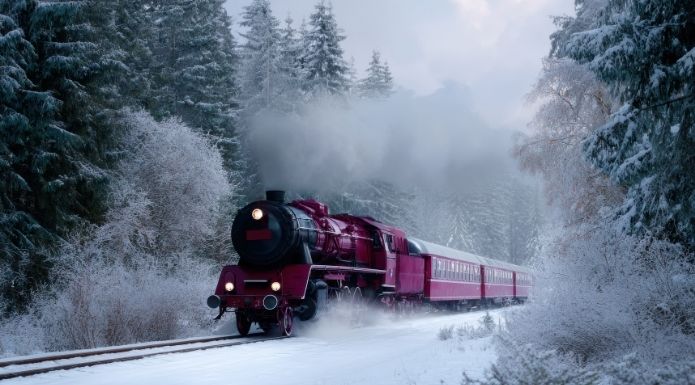
The absurdity is foundational. If a society has the staggering resources to construct a globe-circling track and an armored, self-sustaining “Dreamliner” capable of traversing a frozen wasteland forever, they have the resources to build one heck of a stationary bunker. A stationary “home” would be exponentially more efficient, easier to insulate, and wouldn’t waste massive amounts of energy fighting the friction and rolling resistance of a never-ending journey.
But a stationary bunker doesn’t allow for a high-speed revolution in a tube. In Snowpiercer, the science didn’t build the world; the social experiment did, and the physics was just tacked on as an afterthought.
The “Official” Narrative: The Eternal Engine
To understand the scientific failure, we have to look at what Wilford Industries claims is happening. In the internal logic of the story, the world didn’t just freeze; it became a thermodynamic tomb.
- The Eternal Engine: The train is powered by the “Eternal Engine,” a device designed by Melanie Cavill (at least in the series timeline) that is explicitly described as a perpetual motion machine. It is the “Holy Grail” of physics—a closed-loop system that supposedly generates more energy than it consumes.
- The “Motion is Life” Mandate: According to the plot, the train must stay in motion to:
- Generate Heat: The kinetic energy of the wheels on the track is supposedly harvested to keep the cars from freezing solid.
- Produce Water: The “Snow-Chute” at the front intake collects snow and ice, which is then melted by the engine’s heat to provide water for the hydroponics and passengers.
- Prevent Seizure: The claim is that if the train stops for even a few minutes, the sub-zero temperatures would cause the metal to contract and the machinery to “freeze” permanently to the tracks.
The Physics Reality Check
This is where the “Science as a Prop” comes in. The show treats the Eternal Engine as a magical artifact that justifies the train’s existence. But even if we accept the “magic” of the engine, the circular reasoning remains a crime against logic.
- Kinetic Recycling: If the Engine is truly “Eternal” and generates infinite energy, using the movement of the train to create heat is like trying to charge a battery by plugging it into itself while running a hair dryer.
- The Thermodynamic Tax: Every time those wheels turn, you lose energy to friction, sound, and vibrations. If you have a magic engine, the most efficient way to use it is to stay still and pump that energy directly into a heater.
The “Snow-Chute” Logistics: High-Speed Hydration
Don’t you hate it when you want to make shovel some snow but you can’t run fast enough? Perhaps the most egregious example of the “Motion is Life” myth is the train’s water reclamation system.
- The Intake Problem: The plot claims the train must maintain high speeds to “scoop” snow into the front intake to be melted for the greenhouses and passengers.
- The Static Solution: In any sane survival scenario, if you are surrounded by a global ice sheet, you don’t need a 100mph intake. you need a shovel and a heating element. By staying stationary, you could harvest as much water as you need without wasting gigajoules of energy on aerodynamic drag and rail friction.
- The Sane Person Puncture: The “Snow-Chute” isn’t an engineering necessity; it’s a way to keep the characters (and the audience) from asking why they don’t just park the train in a nice, well-insulated valley and wait for the sun to come back.
The Track Paradox: The World’s Longest Maintenance Nightmare
The show relies on the idea that the train is the ultimate snow plow—a 100mph “Magic Brush” that keeps the path clear. But this ignores the most basic laws of geology and thermal expansion.
- The Heave and Buckle: In a world that is 100°C, the ground isn’t just “frozen”; it is a dynamic, shifting force. Frost heaving would buckle the tracks, crack the concrete pilings, and shift the alignment of the rails within the first season. A train moving at 100mph hitting a rail that has shifted even an inch out of alignment isn’t a “snow plow”—it’s a kinetic missile.
- The Maintenance Void: Who is maintaining the bridges? Who is clearing the avalanches? The show suggests the train “plows” its way through, but if a ten-ton block of ice falls onto the track, the train doesn’t “plow” it; the train derails. In a survival scenario, you don’t build a 40,000-mile failure point.
- The “Fictional Logic” Trap: Fans argue that as long as it’s “internally consistent,” it’s fine. But Science Fiction carries a burden that Fantasy doesn’t. If you cite “Thermodynamics” and “Engineering” in your pilot, you have to obey the laws of physics. You can’t call it an “Engine” if it acts like a “Magic Wand.”
The “Snow-to-Energy” Myth
Some fans even try to argue that the snow itself provides the energy via some hand-wavy “hydrogen fusion” or “thermal exchange.”
- The Energetic Reality: Collecting and processing snow while moving at high speeds is an energy-negative activity. You are spending more energy to overcome the drag of the intake and the weight of the snow than you could ever possibly extract from it.
The Final Verdict: The Geometric Cage
The “Static Cold” argument—the idea that the planet is so frozen it’s effectively “stable”, is the final piece of nonsense we need to puncture. Frozen doesn’t mean FROZEN, as in still, unmoving, non-shifting, unchanging, immutable…you get it.
- The Box is Better: If you have the energy of an “Eternal Engine,” a stationary box (a bunker) is superior in every thermodynamic metric. It’s easier to insulate, has zero friction loss, and doesn’t have 40,000 miles of failure points.
- The Metaphorical Constraint: The only reason the train exists is that it permits a one-dimensional social hierarchy. Unlike the “levels” in a vertical society like Silo (based on the Wool series), a train forces a binary: you are either at the front or the back.
- The “Have-Nots” as a Prop: The writers didn’t build a world; they built a stage for a class war. They needed the “Tailies” to be physically distant from the “Engine,” and a linear tube was the most literal way to represent that struggle.
Final ScreenLab Conclusion: Snowpiercer is the ultimate example of “Science as a Prop.” It’s a social experiment that uses a Perpetual Motion Machine to justify a metaphor, violating every law of thermodynamics to ensure the plot stays on the tracks.
The Golden Ticket Note: The Wonka Architecture: If you strip away the frozen wasteland, Wilford is just an industrial-strength Willy Wonka. Both utilize the Funhouse Governance trope: a reclusive, god-like eccentric creates a closed-loop system to “test” the moral worth of the survivors.
In Snowpiercer, the prize is the Engine. In Willy Wonka, it’s the Factory. Then, in Ready Player One, Halliday provides an “Altruistic Overwrite” of this same logic, creating a digital version of the “Boxed-In Dystopia” where the have-nots can compete for the keys to the kingdom. In all three cases, the “Great Inventor” chooses to bypass actual social solutions in favor of a curated, high-stakes game. It turns out that whether you’re fighting over a Golden Ticket or a seat in First Class, you’re still just a component in someone else’s simulated reality.
Further Case Files
- The Interstellar Hydration Fallacy: Why Invading Earth for Water is a Tactical Disaster — If you thought a 100mph snow-plow was bad engineering, wait until you see the logistics of alien water-thieves.
- The Sci-Fi Schlock Field Guide: Spectral and the Art of the Scientific Shrug — A masterclass in how to spot movies that treat “Science” as a magic wand for plot convenience.
- The Ragdoll Paradox: Why Your Hero is Actually a Liquefied Corpse — An audit of the structural integrity of the human body, which is usually the first casualty in an action-heavy “dystopian” setting.
- The Survivalist Fallacy—Why the ‘Savage’ Genre is a Psychological Fraud — A deep dive into the “Lord of the Flies” logic that Wilford uses to keep his train on the tracks.