
The Scaling Problem: Surface Area vs. Volume
In science fiction, creating a giant insect is often treated as a simple matter of magnification. However, physics does not scale linearly. The Square-Cube Law dictates that as an object grows in size, its volume (and mass) grows much faster than its surface area.
- The Math: If you scale an insect up by a factor of 10, its Surface Area increases by 100x (10²), but its Volume—and therefore its weight—increases by 1,000x (10³).
- The Weight Trap: This means a giant insect is 10 times heavier than its legs are strong.
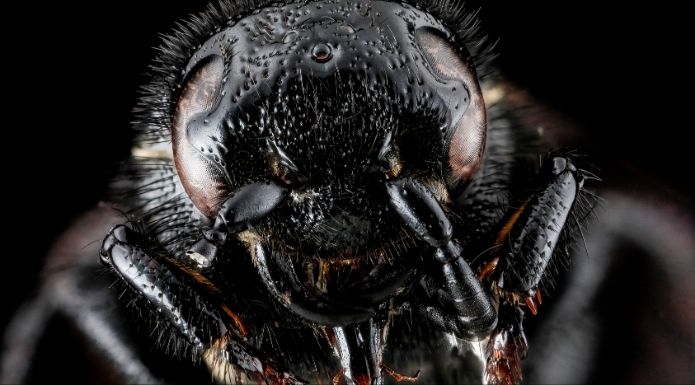
Biological Ground Truth: Structural Collapse
The most immediate Smoking Gun for the impossibility of a giant insect is Compressive Strength. While an ant can lift 50 times its body weight at its natural size, that strength is a product of its small scale.
- Limb Failure: An insect’s legs are thin tubes of chitin. As the mass increases up to 1000 times, the Static Load on those limbs exceeds the Tensile Strength of the material. A tank-sized bug wouldn’t be a predator; its legs would snap like dry spaghetti the moment it tried to stand. In order for an insect to become like the giant insects depicted in sci-fi, it’s exoskeleton would have to be made of a completely different material, with a much higher tensile strength.
- Exoskeleton Limits: To support that kind of weight, the exoskeleton would need to be so thick and heavy that the insect would have no room left for muscles or internal organs.
The Metabolic Hard Ceiling: Just as the Square-Cube Law creates a “Respiratory Wall” for giant insects, the laws of thermodynamics create a “Thermal Wall” for cinema’s favorite healers. If you think a tank-sized bug has a fuel crisis, wait until you see the caloric debt required to regrow a limb in sixty seconds.
Read the Audit: The Rapid Healing Factor: Cinema’s Most Expensive “Magic Wand”
Why Giant Insects Can’t Simply Have Stronger Exoskeletons
It is often suggested that a giant insect could simply evolve a thicker or stronger exoskeleton to compensate for its mass. However, this ignores the Weight-to-Strength Ratio. Chitin is an exceptional biological polymer for small organisms, but it lacks the Compressive Strength required to support multi-ton loads. To survive at the scale of a Starship Troopers Arachnid, the specimen’s armor would need the properties of Reinforced Carbon Fiber, a material that lacks the biological flexibility required for joints and movement.
- The Weight-Strength Paradox: Even if the insect evolved a “super-material” exoskeleton, the thickness required to prevent the legs from buckling under several tons of pressure would make the armor so heavy that the insect would need even more muscle to move. A giant insect that could support it’s own weight would need to be more giant.
- The Fuel Problem: More muscle requires more energy (ATP) and more oxygen. This sets up a collision course with the Respiratory Wall. This means the insect would literally starve its own muscles of fuel just trying to take one step.
- Biological Ground Truth: Chitin has a tensile strength of about 80-100 Megapascals (MPa). For comparison, human bone is about 130 MPa and steel is 400 MPa. A giant insect is effectively trying to build a skyscraper out of balsa wood.
Architecture of Scale: Exoskeletons vs. Endoskeletons
A common question arises: If human bone is only slightly stronger than chitin in terms of Tensile Strength, why can elephants and whales exist while giant insects cannot? The answer lies in Structural Architecture.
- The Hollow Tube Limit: An exoskeleton is essentially a series of hollow tubes. While a tube is incredibly strong for its weight at a small scale, it is prone to local buckling as it gets larger. To support the weight of a giant insect, the “walls” of its legs would need to be so thick that they would eventually meet in the middle, effectively becoming solid.
- The Endoskeleton Advantage: Large mammals rely on an internal Endoskeleton. By placing the “support beams” (bones) in the center of the limb and surrounding them with muscle, the body can distribute Compressive Stress more efficiently. This allows vertebrates to reach massive sizes without their “armor” becoming a literal cage of dead weight.
- The Weight of Armor: For a giant insect to have an exoskeleton thick enough to prevent its legs from snapping, the armor itself would become so heavy that the creature would require an impossible amount of muscle, and fuel, just to lift its own limbs.
Case Study: The Arachnid Specimen: In ScreenLab’s audit of the Hive Mind Kill-Switch, I examine how the film ‘Starship Troopers’ utilizes giant insects that defy the Square-Cube Law. Not only would these creatures suffocate, but their skeletal architecture would fail the moment they attempted to move at the speeds depicted on screen.
The Respiratory Wall: Passive Diffusion vs. Metabolic Demand
The most common scientific “hand-wave” in giant insect films is the assumption that bugs breathe like mammals. They do not. While humans use active lungs and a closed circulatory system to pump oxygenated blood, insects rely on Passive Diffusion. They do not actively draw in air with the help two sacs and a muscular diaphragm! Insects do not “inhale” at all.
- The Mechanism: Insects breathe through tiny holes in their sides called spiracles, which lead to a network of tubes called tracheae. Oxygen simply “drifts” through these tubes to reach the internal tissues.
- The Scale Problem: Passive diffusion only works over very short distances (a few millimeters). As an organism gets larger, the oxygen cannot “drift” far enough into the body to reach the deep tissues and vital organs.
- The Carboniferous Exception: The only reason eagle-sized insects existed 300 million years ago was that Earth’s atmosphere was roughly 35% oxygen (compared to 21% today). The higher partial pressure effectively “pushed” more fuel into their systems.
The Fuel Crisis: Atmospheric Starvation
Even if we ignore the structural collapse of the limbs, a giant insect on modern Earth would face an immediate Metabolic Fuel Crisis.
- Energy Inefficiency: Moving a multi-ton body requires an immense amount of ATP (cellular energy). In our 21% oxygen atmosphere, a giant insect could not take in enough oxygen to “combust” the fuel needed to move its own heavy exoskeleton.
- The “Slow-Motion” Suffocation: The creature wouldn’t just drop dead instantly; it would be perpetually exhausted, move in agonizing slow motion, and eventually suffer from systemic Metabolic Collapse. It is physically impossible to fuel a high-mass, high-activity predator through a passive respiratory system at current atmospheric densities.
The Dinosaur Exception: Why Endoskeletons Aren’t Enough
If the Square-Cube Law is a universal wall, how did massive sauropod dinosaurs reach weights of 60 to 80 tons? The answer is that they didn’t just have an endoskeleton; they had a Pneumatic Workaround.
- Hollow Engineering: Dinosaurs—much like modern birds—evolved Pneumatic Bones. These bones weren’t solid; they contained air sacs that reduced the overall density of the skeleton without sacrificing Structural Rigidity.
- The Biological Weight-Loss Program: This “honeycomb” structure allowed a 40-foot-tall dinosaur to remain light enough to move while still maintaining the Tensile Strength required to support its mass.
- The Contrast to Insects: A giant insect lacks this luxury. Its exoskeleton is its only support, and it must be solid and thick to avoid buckling. It is essentially wearing its weight on the outside, whereas the dinosaur integrated its “lightening the load” technology directly into its frame.
For a giant insect to reach the scale of a dinosaur, it wouldn’t just need a “better” exoskeleton; it would need to completely abandon its biological blueprint and invent an entirely new system, relying on internal support and active breathing. In other words, it would need to cease being an insect.