
In the era of traditional animation, movement was a precious commodity. Whether it was the hand-painted cels of the golden age or the painstaking frame-by-frame adjustments of stop-motion, every shrug, step, and facial twitch represented a significant investment of time and capital. This “budget of restraint” forced a natural discipline: if a character moved, that movement had to be meaningful.
Enter the age of Rigid Body Dynamics and procedural animation. Today, with industry-standard tools like Houdini, movement has become “cheap.” We have removed the financial and physical restraints, and the result is a new cinematic phenomenon: The Over-Animation Trap. The creatures in A Quiet Place (2018) are the ultimate victims of this trap, a monstrous Bugs Bunny on steroids that bumbles through the world simply because the software makes it so easy to do so.
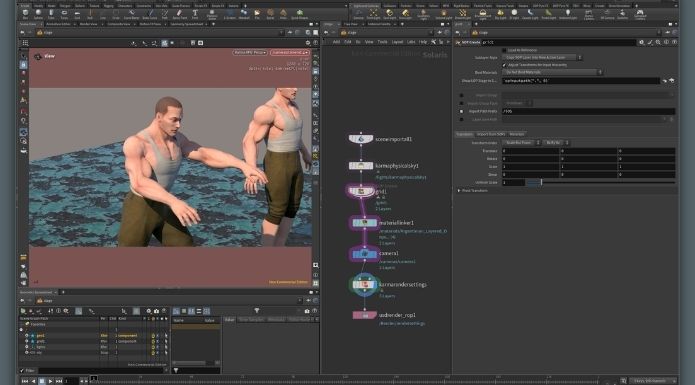
The Collision Physics “Flex”
In a high-budget VFX pipeline, technical directors use Collision Geometry to ensure that digital entities interact realistically with their environment.
- The Tech Goal: To prove the CGI character is “physically there” by having it crush car roofs, smash through farmhouse walls, and send debris flying.
- The Cartoonish Failure: As established in ScreenLab’s biological audit of the Death Angel, these are supposed to be acoustic predators. By utilizing Houdini’s powerful physics engines to show the creature smashing every object in its path, the animators accidentally “animated away” the creature’s logic. A predator that hunts by sound would not evolve to be a walking demolition derby.
The Houdini “Wrecking Ball”: Houdini (developed by SideFX) is the industry standard for Procedural FX. Unlike traditional animation software where every movement is hand-drawn, Houdini uses a node-based system to “simulate” physics.
— Rigid Body Dynamics (RBD): This is the tool used to calculate how a car crumples or a brick wall shatters.
— The Problem: Because Houdini makes it mathematically “easy” to simulate massive destruction, it creates a Simulation Bias. Animators are often tempted to have a creature smash through a wall simply because the software can calculate the debris so beautifully, even if it makes the creature look like an uncoordinated bumbling mess.
Retargeting and the “Human” Weight Problem
To sell the mass of these entities, studios often use Motion Capture (MoCap). They record a human performer and “retarget” that data onto the creature’s digital skeleton using Autodesk Maya.
- The Efficiency Gap: Humans are top-heavy and move with a lot of “secondary” motion—fidgeting, weight shifts, and uncoordinated momentum.
- The Over-Animation Result: When you map human-centric physics onto a specialized hunter, the creature loses the “surgical grace” of an apex predator. Instead of the ghost-like silence of a stalking leopard, the Death Angel moves with the frantic, wasted energy of an over-animated cartoon character.
The Maya “Retargeting” Trap: Autodesk Maya is the “Swiss Army Knife” of the VFX world, primarily used for character rigging and animation. One of its most powerful features is Retargeting, which allows studios to take Motion Capture (MoCap) data from a human actor and map it onto a non-human digital skeleton.
— The Weight Fallacy: When you retarget a human’s movements onto a creature like the Death Angel, you are importing human-centric physics. Humans shift their weight, fidget, and move with a “heavy” momentum that is antithetical to a precision hunter.
— The Result: Maya makes it incredibly fast to get a creature moving, but without heavy manual “cleanup” by a skilled animator, the result is a creature that feels like a person in a rubber suit, fidgety, frantic, and “over-animated.”
The “Because We Can” Fallacy
Modern VFX software is so powerful that it can calculate the structural failure of a brick wall in seconds. Because it is now technically “easy” to show a monster crashing through a house, production often prioritizes that Visual Complexity over Narrative Logic.
- The Comparison: A lower-budget film is often forced to be scarier because it can’t afford to show the monster smashing a car. They have to rely on sound design and subtle shadows.
- The Trap: A Quiet Place had the budget to show everything, so they did. They traded the “terrifying silence” of a perfect hunter for the high-decibel spectacle of a physics simulation.
The ScreenLab Reality: High-end technology should be a tool for precision, not an excuse for clutter. When you use $100M of software to turn a “silent” predator into a bumbling wrecking ball, you haven’t made it more real—you’ve just made it more animated.
The “Apes” Paradox: Economy vs. Excess
To understand how badly the Death Angels are over-animated, we only need to look at the modern Planet of the Apes trilogy. Both productions utilized cutting-edge Motion Capture and Retargeting in Autodesk Maya, but the philosophy of movement couldn’t be more different.
- The Apes (Economy of Motion): The VFX team at Weta Digital spent years studying primate behavior to ensure that Caesar and his followers moved with absolute efficiency. There is no “wasted” movement. When an ape sits, it stays still. When it moves, it does so with a specific, grounded purpose. This restraint is what makes them feel “real”—the technology is being used to limit the animation to what is strictly necessary.
- The Death Angels (The Fidget Factor): In contrast, the Death Angels move with a frantic, jittery energy that suggests the animators were afraid the audience would stop believing in the monster if it stayed still for a single second. It’s the “Bugs Bunny on Steroids” effect: constant, unnecessary interaction with the environment that screams “I am a digital effect!”
The ScreenLab Reality: Believability isn’t born from how much a creature can move, but from how much it doesn’t. The Apes films used MoCap to capture the soul of a living being; A Quiet Place used it to power a wrecking ball.
The Retargeting Trap: Humans vs. Predators
The real failure isn’t how the technology was utilized, but that it was utilized at all. In Planet of the Apes, the human performance isn’t a “template” to be overwritten; it’s a biological foundation. Because apes and humans share a similar skeletal architecture, the Retargeting in Autodesk Maya is actually faithful to physics. When Andy Serkis shifts his weight, that movement translates logically to Caesar because the anchor points, shoulders, hips, knees, are in the right place.
But with the Death Angels, that same technology becomes a trap. The creators took a top-heavy, bipedal human and tried to “stretch” their movements onto a multi-limbed, armored extraterrestrial.
- The Apes (The Trained Anchor): The actors went through “Ape Camp” to unlearn human gait. They used arm-extenders and studied primate biomechanics. When the Weta Digital team used MoCap, they were capturing a pre-calibrated biological performance. The technology was simply a bridge for a performance that already respected the laws of physics.
- The Death Angels (The Technology Trap): No amount of human training can mimic a creature with the anatomy of a Death Angel. By using humans to “model” these creatures, the production fell into the Software Default. They let the Maya Retargeting engine do the heavy lifting, which resulted in a monster that moves like a human in a frantic, digital suit.
The Irony of “Ease”
Easier isn’t always better. In Apes, the technology was used to capture restraint. The actors knew that a real ape doesn’t fidget; it conserves energy. In A Quiet Place, the ease of the Houdini physics engine encouraged activity. The animators mistook “busy-ness” for “realism,” resulting what I called Bugs Bunny on Steroids” at the beginning of this report; a bumbling buffoon of a predator that contradicts the Acoustic Predator’s biological need for silence.
The ScreenLab Reality: Performance capture is only as good as the biological logic behind it. If you use a human to model an ape, you get a masterpiece of “Economy of Motion.” If you use a human to model an alien acoustic predator, you get a high-tech biological wrecking ball that may as well be crashing into giant bowling pins.