In the world of science fiction and superhero cinema, injury is often treated as a temporary inconvenience. Whether it’s a medical officer shining a blue LED “dermal regenerator” on a phaser burn or a mutant regrowing a limb in a matter of seconds, the trope of Rapid Healing is a staple of the genre. Movies often hand-wave these feats as being a “souped-up” version of natural biological processes, like a chameleon regrowing a tail or an axolotl regenerating a limb. But in reality, you cannot simply “turn up the speed” on biology without breaking the laws of physics. Scaling these processes from months to minutes creates a series of catastrophic failures that would kill the “healer” long before the wound closed.
The Biological Price Tag: What the Movies Ignore
In this audit, we are diving into the “Nuts and Bolts” of why rapid healing is a thermodynamic and physiological impossibility. I will be breaking down the four specific “Smoking Guns” that would turn a superhero into a biological disaster:
- The Caloric Debt (The Fuel Crisis): Healing isn’t free. Regrowing mass in seconds requires an energy input equivalent to a lightning strike.
- The Thermal Limit (The Spontaneous Combustion Problem): Accelerated protein synthesis is an exothermic reaction. A “healing factor” would produce a massive fever that bakes your brain and fries your internal organs from the inside out.
- The Cancer Paradox (The Hayflick Limit): By forcing cells to divide at impossible speeds, you aren’t just healing—you’re using up your entire lifetime’s quota of cellular divisions in a single afternoon.
- The Scaling Fallacy: Why the “Axolotl Argument” fails when you move from cold-blooded amphibians to high-metabolism mammals.
Standard Procedure: How Biology Actually Repairs Damage
In movies, healing is often “state change”, a wound is there, and then it isn’t. In reality, your body treats an injury like a high-stakes construction project. It is a slow, multi-stage process that cannot be rushed without structural consequences.
- Hemostasis & Inflammation (The Cleanup): Within seconds, your blood clots to stop the leak. Then, an army of white blood cells rushes to the area to “eat” bacteria and debris. This is why wounds get red, swollen, and hot.
- Proliferation (The Framing): Over the next few days, your body builds a “scaffold” of Collagen. Think of this scar tissue as the biological rebar. New blood vessels grow into the area to fuel the construction.
- Remodeling (The Patch Job): This stage is the longest, lasting months or even years. The body attempts to replace the rushed, disorganized “emergency tissue” (scar tissue) with more functional structures.
- The Reality of Scars: Scar tissue is essentially a “quick-fix” made of dense collagen. It lacks the elasticity, hair follicles, and sweat glands of original skin.
- The Permanent Patch: Depending on the depth and severity of the wound, the remodeling process often fails to fully replace the scar. The body prioritizes closure over perfection, leaving behind a permanent, rigid patch that is structurally inferior to the original tissue.
The ScreenLab Reality: Cinema healers have “pore-perfect” skin seconds after an injury. In reality, a “Rapid Healing Factor” that skips the careful remodeling phase would likely result in a character covered in thick, knotted, and non-functional Hypertrophic Scars, as the body never has the time to refine the emergency patch job.
Trade Journal: The VFX of “The Glow”: In modern VFX pipelines, the “magic” of rapid healing is often sold through a technique called Subsurface Scattering (SSS). This is a rendering method that simulates how light penetrates the surface of a translucent object—like skin or wax—scatters at different angles, and exits at a different point.
— The Cinematic Illusion: Artists use SSS to give the regrowing tissue a soft, ethereal “inner glow.” It makes the new skin look fresh, healthy, and “magically” clean.
— The Burning Reality: If a film were to be scientifically accurate, that “glow” wouldn’t be soft, translucent light. Given the Metabolic Thermogenesis required for that speed of repair, the area should be glowing white-hot.
— The Smoking Gun: Instead of a gentle blue or pink hue, the specimen’s skin should realistically be emitting incandescent thermal radiation. If you see “Subsurface Scattering” used to show a wound closing in seconds, you are looking at a direct violation of the laws of thermodynamics.
The Caloric Debt: The 40,000-Calorie
While the prospect of permanent, non-functional hypertrophic scarring is a significant biological hurdle, it is arguably the least of a “healer’s” worries. The single biggest hand-wave in cinema—the one that ignores the very laws of thermodynamics—is the assumption that healing is “free.”
In reality, biology is a strictly governed accounting system. To regrow a limb or seal a gaping wound, the body must synthesize a staggering amount of protein, bone, and cellular structure. That construction requires fuel, and the math simply doesn’t add up.
Another Fantastic Trope: The Multiverse means everything will happen! Nope, hot dog fingers are not a part of any “parallel Earth.”
The Math of Mass
To regrow a human-sized arm (approximately 4kg of muscle, bone, and connective tissue), a biological organism requires an estimated 30,000 to 40,000 calories of raw energy.
- The Cinema Timeline: A standard “healing factor” or dermal regenerator typically regrows a limb in roughly 60 seconds.
- The Caloric Reality: To achieve this, the specimen would need to burn through a month’s worth of food in a single minute. For comparison, a professional athlete at peak performance burns roughly 4,000 calories in an entire day.
- The Result: The character wouldn’t just be “hungry.” Their blood sugar would drop to zero instantly, leading to immediate hypoglycemic shock, cardiac arrest, and brain death before the elbow even formed.
The ScreenLab Reality: Unless your hero is literally plugged into a high-voltage power grid or consuming 50,000 calories a second during the process, they aren’t “healing”, they’re starving to death at a molecular level.
While the regrowth of an entire limb is the extreme end of this trope, the same physics apply to the “fatal slash.” In gritty modern deconstructions like The Boys, characters are often seen instantly “zipping up” massive abdominal wounds that should be terminal.
From a physiological standpoint, this is a Systemic Crisis. Repairing a ruptured organ and sealing a foot-long laceration in seconds requires a localized metabolic surge so intense that it would effectively “drain the battery” of the rest of the body. You aren’t just repairing a wound; you are cannibalizing the energy required to keep the heart beating and the lungs inflating just to “stitch” the skin.
The Blood Volume Paradox
Beyond the energy required to “knit” the skin, there is the matter of Mass Conservation. In the case of a specimen like Kimiko in “The Boys” being slashed open, the pavement is literally covered in several liters of her blood.
- The Cinema Illusion: The wound “zips up,” the character gasps for air, and they stand up to continue the fight.
- The Bloody Reality: Closing a wound does not replace the lost fluid. A human being who loses 40% of their blood volume enters Hypovolemic Shock. Their heart no longer has enough fluid to pump, their blood pressure bottoms out, and their brain begins to die from lack of oxygen.
- The Result: Even if the “healing factor” seals the abdominal wall perfectly, the character should remain a pale, unconscious corpse. Unless the power also includes Instant Hematopoiesis (the creation of new blood cells and plasma from nothing), the “healed” hero is just a closed bag with no pressure in the system.
The ScreenLab Reality: Cinema treats the “skin” as the character. Biology treats the “circulatory system” as the life support. Healing the skin while the blood is still on the pavement is like fixing a punctured tire but forgetting to put the air back in—the vehicle is still going nowhere.
The “Secondary” Energy Crisis: Blood Synthesis & Oxygenation
Let’s imagine that the blood loss is being replaced during the minute or two our rapid-healing hero is “unconscious.” This requires a number of extremely unlikely mechanisms, while still encountering the same caloric cost problem. Replacing the blood before the wound is healed would simply result in the blood pouring out of the still open wound. You have to patch the hole before you fill the tank.
The “Death-State” Workaround
- The Problem: If the heart is stopped to “seal the tank,” the brain begins to die within 4 to 6 minutes due to Anoxia (lack of oxygen).
- The Massive Debt: To prevent brain death, the “Healing Factor” would need to facilitate Extracellular Oxygenation. It would have to manually move oxygen molecules into every neuron without the help of a heartbeat. Otherwise the beating heart would cause the regenerated blook to bleed away.
- The “Construction” Cost: Replacing 4 to 5 liters of blood isn’t just about “adding water.” It requires the instant synthesis of roughly 20 to 30 trillion red blood cells, plus plasma proteins and platelets.
The ScreenLab Reality: Replacing a full blood supply in a “death-like state” is the metabolic equivalent of trying to rebuild an entire car engine while the car is still traveling at 60 mph, and doing it without letting the temperature of the metal rise by a single degree. Even if the character survives the “slash,” the energy required for Instant Hematopoiesis (blood creation) would likely cause the body to “short circuit” from sheer metabolic demand.
The Thermal Limit: The Brain-Baking Paradox
Even if we ignore the ‘Empty Tank’ problem, and assume the body can magically find the 40,000 calories required to rebuild the mass, we hit a final, insurmountable wall of physics: Heat.
In biology, building things is an Exothermic Reaction. Every time your body synthesizes a protein or assembles a cell membrane, it loses a portion of that energy as waste heat. This is known as Metabolic Thermogenesis.
The “Incendiary” Healing Factor
In a normal human healing timeline, the heat generated by healing a wound is dissipated easily through the skin and breath over several days. But when you compress that timeline into sixty seconds, you aren’t just healing, you are effectively turning into a biological furnace.
- The Ground Truth: High-speed protein synthesis is a violent chemical event. If you force months of cellular assembly to occur in a minute, the resulting thermal spike would be catastrophic.
- The “Brain-Baker” Fever: The human brain is incredibly sensitive to temperature. A fever of 105°F (40.5°C) is a medical emergency; a fever of 108°F (42.2°C) causes permanent neurological damage or death.
- The Scorching Reality: The energy required to “zip up” a massive fatal wound in seconds would raise the specimen’s core temperature by dozens of degrees. Before the skin even finished closing, the character’s internal organs would reach the boiling point of water.
The ScreenLab Reality: A realistic “Rapid Healer” wouldn’t just stand up and walk away; they would spontaneously combust. Their blood would turn to steam, and their brain would be literally “baked” inside their skull by the very metabolic process trying to save their life.
The Cancer Paradox: The Hayflick Limit
In the movies, rapid healing is the ultimate fountain of youth. In reality, it is a biological “overdrive” that burns through your lifetime’s supply of cellular divisions in a single afternoon. This is due to a fundamental biological ceiling known as the Hayflick Limit.
The Cellular Expiration Date
Most human cells are not immortal. Every time a cell divides, the Telomeres, the protective caps at the end of your DNA, get a little bit shorter. Once those caps are gone, the cell can no longer divide and either dies or becomes “senescent.”
- The Cinema Illusion: Characters like Wolverine can rapidly heal from massive injuries and so so thousands oft times over decades without any apparent loss of function.
- The Cellular Reality: Forcing your body to regrow mass at superhero speeds requires a massive, coordinated “burst” of cell division. By zipping up a fatal wound in sixty seconds, you are forcing your cells to undergo years’ worth of divisions in a minute.
- The Result: A character who heals rapidly from enough major injuries would likely reach their “Hayflick Limit” before they hit their 30th birthday. Their body would simply stop repairing itself, leading to systemic organ failure and “accelerated aging” at a cellular level.
The “Immortality” Can of Worms
Therefore, to achieve super healing, you have to solve the telomere problem; you must do away with pre-programmed call death. By doing so, you you immediately trigger the next influx of squirming worms from this ever-growing can.
- The Error Accumulation Problem: If cells never die and divide at high speeds, the chance of a “copy-paste” error in the DNA skyrockets. Without a programmed death cycle, those errors aren’t purged, they’re duplicated. This leads to Genomic Instability, which is the fast track to a body made of non-functional, mutated tissue.
- The Specialized Cell Crisis: Not all cells divide. Neurons and heart muscle cells are famously stubborn. If your “immortality” solution only fixes the dividing cells (skin, blood), you end up with a character who has a perfect “young” face but a brain and heart that are still decaying at the normal rate.
- The “Eternal Tumor” Risk: In biology, a cell that has no “pre-programmed death” and divides rapidly is called a Hela Cell (cancer). By achieving “immortality” through super-healing, the specimen effectively becomes one giant, self-repairing tumor.
The ScreenLab Reality: To achieve the “pore-perfect” healing seen in cinema, you have to trade away the very mechanism that prevents your body from turning into a runaway cancer. Super-healing doesn’t just “side-step” biology; it destroys the organism itself. A rapid healing human isn’t an immortal hero; he is a collection of immortal devastating errors.
The Scaling Fallacy: The Axolotl Argument
When confronted with the impossibility of rapid healing, defenders often point to nature. “Lizards regrow tails,” they say. “Axolotls can regenerate entire limbs and even portions of their brains. Why can’t a human just do that, only faster?”
This is a Scaling Fallacy that ignores the fundamental differences between cold-blooded amphibians and high-metabolism mammals.
The Engine vs. The Lightbulb
An axolotl is a low-energy, ectothermic (cold-blooded) organism. Its metabolic “engine” idles at a very low temperature. When it regrows a limb, it does so over weeks or months, not seconds.
- The “Slow-Cook” Advantage: Because the axolotl takes its time, it never hits the Thermal Limit. The waste heat generated by its cellular assembly is dissipated as fast as it is produced.
- The Nutrient Bath: In a notable limb-regeneration “enactment,” Adam Savage once explored futuristic limb regrowth by imagining the patient submerged in a nutrient-rich bath for months. This is the only way to solve the Caloric Debt, by literally soaking in the raw materials needed for construction.
The Mammalian Explosion
If you tried to scale an axolotl’s regeneration up to the size and metabolic rate of a human, and then compressed the timeline into a minute, you would be trying to run a nuclear reactor through a toaster’s wiring.
- Complexity of Mass: Humans are vastly more complex than amphibians. We have intricate vascular systems, high-density bone, and a massive nervous system. “Souping up” this process in a mammal isn’t just speeding up a clock; it’s increasing the “friction” of the reaction until the bodily tissues reach the point of incineration.
The ScreenLab Reality: Nature’s best regenerators succeed specifically because they’re slow and cold. A “Rapid Healing Factor” attempts to be fast and hot. You can have the regeneration, or you can have the speed—physics does not allow you to have both.
The Nanobot Fallacy: Mending vs. Growing
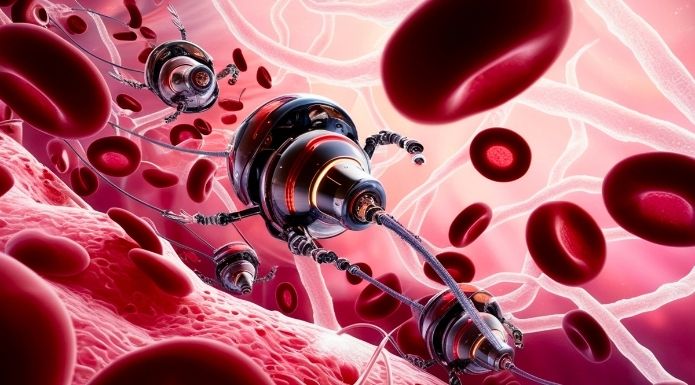
When a script can’t explain away the Caloric Debt or the Thermal Limit, it often reaches for the ultimate hand-wave: Nanotechnology. The trope suggests that an army of microscopic machines (sometimes directed by an onboard AI) can physically “stitch” tissue back together at the molecular level, sidestepping natural biology entirely.
But from a Nuts and Bolts perspective, this creates a new set of catastrophic failures.
The “Grout” Problem
If nanobots are “mending” a wound, what are they using for “glue”?
- The Material Crisis: If they’re using the body’s own raw materials, we are right back to the Caloric Debt, the body still has to synthesize the proteins.
- The Hybrid Nightmare: If the bots bring their own building materials, the “healed” tissue is no longer biological. It’s a bio-mechanical composite. Over time, the specimen’s body would become increasingly rigid and brittle, essentially “reinforced concrete” made of flesh and carbon-nanotubes.
The “Vending Machine” Logistics
If we follow the cinematic logic that nanobots bring their own building materials, we encounter a grotesque logistical nightmare:
- The Diet of Giants: To regrow 4kg of tissue using non-biological materials, the specimen would need to ingest or carry those materials in advance. We are talking about consuming massive quantities of raw carbon, specialized polymers, or even metallic elements.
- The Breakdown Crisis: Even if you “ate the printer ink material,” the bots would have to find it in the digestive tract, break it down at the molecular level, transport it through the bloodstream (likely causing massive blockages), and reassemble it at the wound site.
Modern Reality: What Nanotech Research Actually Looks Like
The magic version of nanobots ignores the incredible, but far more modest, reality of current medical research. We aren’t building “micro-surgeons”; we are building “smart envelopes.”
- Targeted Drug Delivery: The primary goal of current nanotech (like lipid nanoparticles) is simply to get a specific medicine to a specific cell without it being destroyed by the liver along the way. It’s a delivery truck, not a construction crew.
- Smart Scaffolding: Research is being done into “nanofibers” that can be injected into a wound to act as a more efficient version of the Collagen Scaffold discussed above. They don’t “heal” the wound; they just give the body’s natural (slow) cells a better “grid” to grow on.
- Hemostatic Nanoparticles: There is research into particles that can mimic platelets to stop bleeding faster. Again, this isn’t “mending” tissue; it’s just assisting the body’s natural Hemostasis phase to prevent the Blood Volume Crisis.
The ScreenLab Reality: Real nanotech is a assister for existing biology, not a replacement for it. If a movie shows nanobots “zipping up” a wound in seconds, it isn’t science fiction, it’s a magic wand that ignores the fact that even the smallest machine still needs a fuel tank and a supply of bricks.
The AI “Management” Fallacy
The idea that an AI “directs” the healing process assumes biology is simply a poorly managed construction site. In cinema, this usually takes one of two forms:
- The Biological Software Patch: An onboard AI (like a neural link or “auto-doc”) takes direct control of the specimen’s nervous and endocrine systems to “force” a more efficient healing response.
- The Micro-Foreman: The AI acts as a central command hub for an army of nanocytes (as popularized by Star Trek), directing billions of machines to physically mend the damage.
Scenario 1: Directing Biology (The Engine Failure)
If the AI is “directing” your natural biology, it’s still limited by the hardware.
- Hardware vs. Software: You can have the smartest foreman in the world, but if the crane can only lift one ton, the foreman cannot “direct” it to lift ten.
- The Signal Storm: To achieve rapid healing, the AI would have to force your body to dump a lifetime of resources into a wound in seconds. This triggers a systemic Endocrine Collapse. The AI might fix the hole in your chest, but it does so by “short-circuiting” your heart and lungs to pay the energy bill.
Scenario 2: Managing Nanocytes (The Same Debt)
If the AI is using nanocytes, you are simply shifting the Grout Problem to a computer.
- Logistical Mirror: Even with an AI general, the nanobots still face the same Thermal Limit and Mass Conservation issues. An AI directing machines to weld cells together at high speeds still results in tissues that are glowing white-hot from the waste heat of billions of micro-engines.
The Future Hope: Real-World Rapid Healing
After auditing the catastrophic physics of cinematic healing, it’s easy to feel like ScreenLab is a massive Debbie Downer who has just burst your bubble, rained on your parade, harshed your mellow, etc. However, while “instant” regrowth is an impossibility, science is making massive strides in Assisted Acceleration. We aren’t zipping up fatal slashes in seconds, but we are learning how to shave days or weeks off the natural healing timeline for smaller, manageable wounds.
1. Smart Bandages & Electroceuticals
Instead of a “blue light” magic wand, researchers are developing bandages that actively monitor a wound’s environment (pH, temperature, oxygen) and respond in real-time.
- The Science: By using low-level electrical stimulation (Electroceuticals), these bandages can actually “direct” cell migration to a wound site, speeding up the Proliferation phase without triggering a thermal crisis.
2. Hydrogels & 3D Bioprinting
The “Wet Cement” problem we discussed earlier is being solved through advanced materials science.
- The Science: Scientists are using Hydrogels, water-rich polymer chains, that act as an instant, synthetic “scaffold.” In more extreme cases, 3D Bioprinters are being tested to “print” a patient’s own skin cells directly onto a burn or wound, providing an organized structure that biology would normally take weeks to build.
3. Nanotechnology & AI: The Delivery Drivers
Yes, even Nanotechnology and AIs may be a part of the healing process in the future. However, it won’t be robotic micro-surgeons. Instead, its about precision logistics.
- The Science: AI is currently being used to model complex wound-healing trajectories to predict infections before they happen. Meanwhile, Lipid Nanoparticles are acting as “smart envelopes,” delivering growth factors directly to the cells that need them most, ensuring the body’s limited Caloric energy is spent as efficiently as possible.
The ScreenLab Reality: Real rapid healing isn’t a superpower, it’s an engineering feat. It succeeds not by “souping up” the engine until it explodes, but by clearing the traffic and providing better materials for the construction crew. We may never regrow a limb in sixty seconds, but we are getting very good at making sure the body’s “Standard Procedure” is as fast and flawless as physics allows.