
The ScreenLab defines Genre Squatting as the act of occupying a Science Fiction setting while actively loathing the discipline required to maintain it. Andrei Tarkovsky didn’t just pioneer this; he admitted to it. By his own account, he adapted Solaris because he needed the money and the “respected” cover of author Stanisław Lem to bypass Soviet censors.
The Kubrick Conflict: Pretension vs. Physics
Tarkovsky’s 1970 dismissal of 2001: A Space Odyssey as “lifeless” and “phoney” is the ultimate irony. Kubrick and Clarke spent years ensuring the centrifugal gravity and orbital mechanics were grounded scientific foundations. Tarkovsky viewed this technical integrity as a “distraction.” His dismissive attitude toward the physics of 2001 is the birth of the scientific sovereignty delusion. This is the belief that the “Art” of a film is so sovereign that the “Science” must bow to it.
- The ScreenLab Rebuttal: Accuracy isn’t “lifeless”, it’s the floor. If the floor is missing, the “emotional depth” you’re trying to build is just floating in a void. Tarkovsky mistook the Scientific Integrity of 2001 for a lack of soul, when in reality, it was the only thing making the journey believable.
The Shimmering Connection: Tarkovsky’s refusal to engage with the “aggravating” technology of the 1970s created the blueprint for the modern “Vague-Core” movement. If you want to see how this “Scientific Shrug” evolved into today’s muddy, desaturated CGI landscapes, see our audit of the “Shimmer” ecology.
Read the Audit: The Aesthetic Evasion: Annihilation and Vague-Core Sci-Fi
The Isolated Cabin Test: Failed
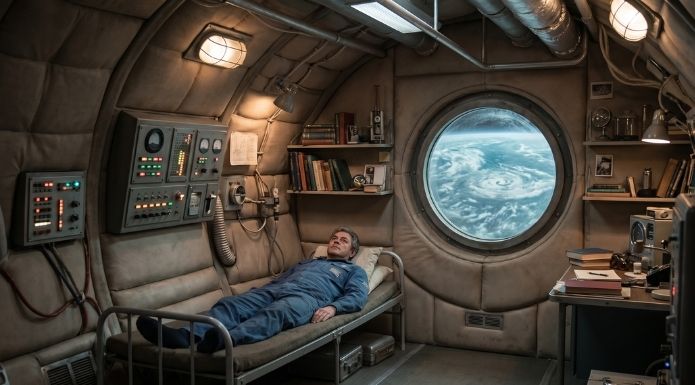
Solaris is the textbook failure of the Isolated Cabin Test. The film concerns a scientist on a space station being “haunted” by a physical manifestation of his dead wife and other people who shouldn’t be on the station, conjured by a sentient ocean.
- The Cabin Swap: If you replace the “Sentient Ocean” with a “Magic Spring” and the “Space Station” with a “Remote Hunting Lodge,” the story remains 100% identical.
- The Evasion: Tarkovsky famously hated the technology of the set, calling the rockets “aggravating.” This is because he wasn’t making a movie about humanity’s contact with the truly alien; he was making a movie about a man’s internal guilt. The science was just a “commercial” wrapper he was forced to use to get paid.
The “Science as a Prop” Legacy
By treating the setting as “wallpaper,” Tarkovsky gave birth to the Vague-Core lineage we see today in films like Annihilation.
- The High-Horse Fallacy: Tarkovsky argued that sci-fi was “shallow” because it focused on invention. Tarkovsky’s approach is the shallow one. It is easy to write about “feelings” in a vacuum; it is difficult to write about humanity when they’re actually constrained by the terrifying, indifferent laws of the universe.
The ScreenLab Reality: Tarkovsky didn’t “elevate” the genre; he hid in it. Solaris isn’t a masterpiece of Science Fiction, it’s a masterpiece of Psychological Overwrites squatting in a space station.
The Wall: When the Cabin is Literal
If you think the Isolated Cabin Test is a reach, look no further than the 2012 film The Wall (Die Wand). This film is the “Purest” specimen of the Genre Squat.
- The Setup: An invisible, impenetrable dome drops over a mountain.
- The Squat: The protagonist stays in a hunting lodge. She doesn’t test the wall’s frequency, or it’s extent. She doesn’t try to dig under it. She doesn’t check for oxygen exchange, and she doesn’t attempt any type of exit. She writes letters.
- The “Frozen Man” Evasion: At one point, she observes a man outside the dome who appears frozen in time. In a work with Scientific Integrity, this would be a foundational clue about time dilation or quantum stasis. In The Wall, it is discarded as Scientific Set Dressing. It exists only to look “eerie” before the movie retreats back to its pastoral “Emotional Depth.”
- The Panic Button: Because the director realized that watching a woman write letters for two hours is cinematic suicide, they drop in a “hostile stranger” out of nowhere just to have a scene of violence. It’s a desperate attempt to add stakes to a world they refused to build.
The King Contrast: Honesty Over Pretension
To see the failure of the “Sovereign” Arthouse approach, we only need to look at Stephen King’s Under the Dome. King is not a science fiction writer, nor does he pretend to be a scientific researcher. However, he succeeds where Tarkovsky and Die Wand fails because he is narratively honest.
- The Dome as a Participant: In King’s world, the characters don’t just write whiny letters about “isolation.” They touch the wall. They measure it. They test its permeability to air and sound. They treat the anomaly as a physical reality that demands a response.
- Reaction vs. Evasion: While the protagonist in The Wall ignores a frozen man to focus on her diary, King’s characters are constantly forced to reckon with the dome’s presence. It isn’t just “set dressing” to facilitate a psychological study; it is the catalyst for the psychology.
- The ScreenLab Verdict: King respects the audience enough to keep the story grounded in the “What” and “How,” even if the ultimate answer is supernatural. Tarkovsky and his descendants treat the “How” as a distraction because they lack the discipline to integrate it.
Solaris is nothing more than a pedagogical lecture disguised as a movie. Tarkovsky wasn’t trying to invite the audience into a new world; he was trying to “fix” their taste by stripping away the very things, the physics, the rules, the stakes, that make the genre meaningful.
Some ScreenLab Film Science
- Why Giant Insects are a Mathematical Impossibility
- The Physics of Rapid Healing: Why Sci-Fi Regeneration Would Spontaneously Combust