
In the world of police procedurals—think NCIS, CSI, Law & Order: SVU, or Criminal Minds—the “Tech Expert” is the ultimate plot-accelerator. The most common tool in their arsenal is the Instant Credit Card Trace. The cops identify a suspect at 14:00, and by 14:05, a glowing dot on a high-tech map shows them exactly which gas station the suspect is currently standing in. There is a common misconception (often reflected in generic search results) that this trope is about tracing fraudulent activity on stolen cards. While banks do have sophisticated real-time alerts for stolen data, that isn’t what happens in these shows. Instead, we see a “hacker” or a tech-cop instantly tracking a criminal who is using their own legitimate credit card for mundane purchases. In the procedural universe, the act of swiping a card is treated like a GPS beacon that pings a police satellite. In reality, this process isn’t just slow, it’s a bureaucratic and technical obstacle course that usually takes days, not seconds.
The Legal Bypass: The 60-Second Subpoena
The most significant hurdle the “Instant Trace” ignores isn’t technical, it’s constitutional. In shows like Criminal Minds or CSI, the transition from identifying a suspect to viewing their financial history happens in the time it takes for a character to walk across a room.
The Friction of the Fourth Amendment
In reality, a credit card statement is a private financial record. Except in very specific “exigent circumstances” (an immediate, active threat to life), a detective cannot simply call a bank and ask for a live feed of a customer’s location.
- The Paper Trail: To access those records, law enforcement must draft an affidavit, establish probable cause, and present it to a judge to obtain a warrant or a subpoena.
- The Judicial Bottleneck: This process doesn’t happen at the speed of fiber-optics. It involves human schedules, courthouse hours, and administrative review.
Diagnostic Cross-Reference: The Retrospective Pattern Illusion: This specific brand of narrative shorthand, where an observer pastes an imagined pattern over a complex network of human chaos, isn’t unique to television writers. We see this exact same cognitive failure running rampant through modern public mathematics. Just as police procedurals treat a credit card swipe like a live GPS beacon while erasing the reality of bureaucratic latency and batch-processing, geographic profiling models mistake local precinct detection limits for a hardwired “buffer zone” in a predator’s brain. In both architectures, the real-world operational friction is entirely ignored to serve a clean, comforting story. Read the full system breakdown: The Detection Bias Fallacy: Why Forensic Mathematics Fails Basic Logic.
The Corporate Firewall
Even after a warrant is signed, it doesn’t grant “remote access” to the bank’s servers. The warrant is served to the bank’s legal compliance department. The bank, not the police, then pulls the requested data and transmits it back.
By bypassing this friction, procedural writers are performing a Bureaucratic Erasure. They treat the bank like a public utility that the police have a “live login” for, rather than a private entity protected by a complex legal framework.
The “Hacker with a Heart of Gold” Shortcut
In procedurals that want to acknowledge the law without actually following it, writers introduce the “Friendly Hacker.” This character, a PI’s old contact or a tech-cop’s “gray hat” buddy, simply bypasses the 60-second subpoena by “logging in” to the bank’s backend.
I won’t digress into a full debunking of “instant hacking” here; suffice it to say that breaching bank-grade encryption isn’t accomplished by frantically typing at a keyboard while a progress bar fills up. It involves slow, methodical exploitation and specialized decryption software. But even if we grant the premise of a “magical” instant hack, the hacker would still hit a secondary, immovable wall: The Latency of Information.
Real-Time vs. Batch-Processing Reality
The “Instant Trace” assumes that the global financial system is one unified, live-streaming pool of data. It isn’t. When a suspect swipes their card at a gas station, that event doesn’t instantly populate a “Master Map” in the bank’s central database.
The Authorization vs. Posting Gap
When you swipe a card, an authorization happens in seconds to check your balance, but that data often stays with the merchant’s local processor or a middle-man service. The actual transaction record, the “posted” data that someone inside a bank’s server would see, is typically processed in batches.
The Synchronicity Lag
Financial institutions often update their viewable transaction logs in cycles (sometimes every few hours or even once a day). A hacker “watching” a bank account wouldn’t see a live GPS ping; they would see a text-based log entry that might not even update for minutes or hours after the suspect has already left the building.
The Fugitive’s Reality: Breadcrumbs vs. Beacons
The most enduring image of this trope is the savvy friend or “hacker” telling an innocent fugitive to “ditch the plastic” because “it’s cash only from here on out.” While the advice is sound, the reasoning in film is usually flawed.
In a procedural, a credit card is a homing beacon. In reality, it’s a breadcrumb trail with a significant delay. Unless a fugitive is hunkering down in a hotel for a week, giving the bureaucratic and technical logs time to catch up, they could theoretically be several states away before an investigator even sees the transaction from that morning’s gas station stop.
The “General Path of Travel”: When the Trope Gets It Right
Once in a while, a procedural will exercise restraint and present credit card data for what it actually is: a record of where a suspect was, not where they are.
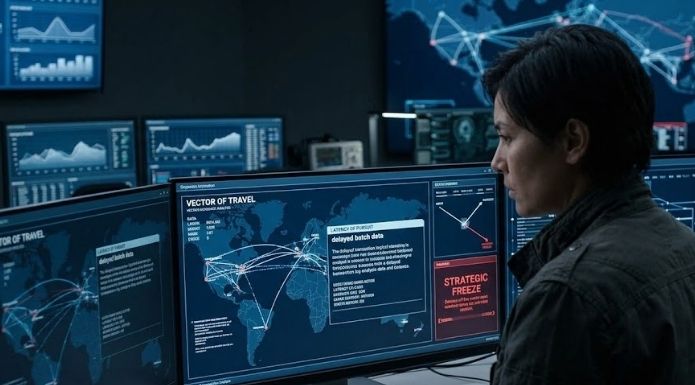
When a show depicts investigators receiving a batch of data that reveals a suspect bought gas in Richmond at 9:00 AM and a sandwich in Raleigh at 12:00 PM, they’re using the data to establish a Vector of Travel. This isn’t a live trace; it’s simply a reconstruction of a path. The word “batch” is important here.
The police will only recieve discrete packets of data containing a group of transactions, while waiting for others to populate and another batch to be sent. Because the data isn’t streaming, investigators are always looking at a “snapshot” of the past. While the police are analyzing a batch of data that puts a fugitive Raleigh three hours ago, the suspect has a massive window of opportunity. They could have doubled back, changed vehicles, or headed in a completely different direction. The “Batch” delay creates a latency of pursuit that makes catching a mobile subject nearly impossible using swiped data alone.
Still, in these rare instances, the drama comes from the investigators trying to guess the destination based on the breadcrumbs, rather than simply “hacking” their way to a real-time capture. This approach respects bureaucratic and legal structure of the real world and actually makes the “cat and mouse” game feel earned.
The Strategic Freeze
If law enforcement wants to stop a fugitive, they aren’t going to “trace” them in real-time to a fast-food counter. Instead, the logical move (if they can secure the legal authority) is to Freeze the Assets.
By cutting off the credit line, the state achieves two things:
- Immobilization: It forces the fugitive into the “cash only” world, which is significantly smaller and slower.
- Predictable Desperation: It forces the subject to seek out alternative resources (family, friends, or banks), creating new, more predictable points of contact for surveillance.
The “Instant Trace” is a narrative shortcut used to generate high-speed tension. When you skip the plodding progress of real-world investigations, the legal hurdles, the batch-processing, and the administrative lag, you aren’t just making the story faster; you’re training the audience to fail to understand how their own world actually functions.