
We’ve all seen the shot: A character with a gleaming titanium arm punches through a concrete wall or lifts the back of a moving semi-truck. It’s the ultimate “cool” factor in sci-fi, popularized by the Six Million Dollar Man and perfected by modern icons like Bucky Barnes. The problem with the “Super-Arm” isn’t the arm itself, it’s the Kinetic Anchor. Hollywood treats a bionic limb like a bolt-on accessory, ignoring the fact that the human body is an integrated kinetic chain. When you add a six-million-dollar arm to a ten-cent shoulder, you aren’t building a superhero. You’re building a biological self-destruct button.
To understand why Bucky Barnes would realistically shred his own torso every time he throws a punch, we have to look at the “Nuts and Bolts” of how force actually travels through a human frame.
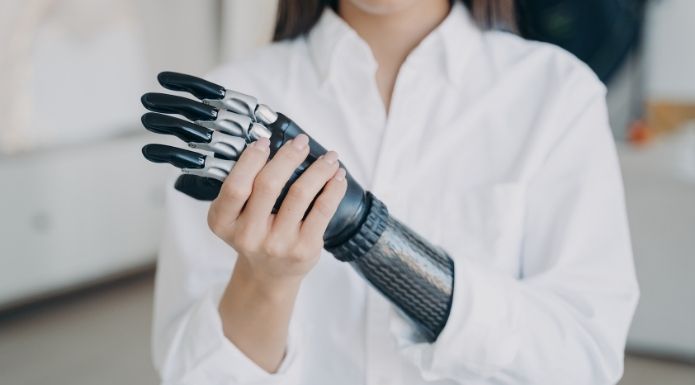
The Myth of the Bolt-On Bicep
In sci-fi, we see a bionic arm lift a 2,000-pound steel beam. The arm itself might be made of carbon fiber and high-torque motors, but the anchor point, the shoulder girdle, is still just porous bone and soft tissue.
1. The Kinetic Chain Collapse
Force doesn’t just stay in the arm. When you lift something heavy, that force travels through your wrist, elbow, shoulder, spine, hips, and finally into the ground. If you have a 6-million-dollar arm attached to a flimsy human shoulder, the first time you try to lift a car, the arm doesn’t lift the car, the car pulls the arm (and your entire scapula) right off your ribcage.
Analyst Note: The Fragility of Freedom Most people treat the shoulder like any other joint, but anatomically, it is a freak of nature. To achieve its phenomenal range of motion, the shoulder sacrifices structural security. The scapula (shoulder blade) is essentially a “floating” bone, it isn’t bolted to the spine or the ribs by other bones; it is held in place entirely by a complex web of muscles and tendons.
While this allows you to throw a baseball or reach behind your back, it makes the joint exceptionally fragile under load. In a six-million-dollar scenario, you are anchoring a high-torque mechanical engine to a biological “floating dock.” The result isn’t a super-lift; it’s a catastrophic kinetic anchor failure where the arm stays still and the human torso is essentially shredded by its own prosthetic.
2. The “Shoulder Girdle” Expansion
If you were to “attach” a mechanical, super-strong arm at the shoulder, you can’t just replace the humerus. To actually use “super strength,” you would have to replace:
- The Scapula and Clavicle: The “floating” bones that provide the base.
- The Pectoral and Latissimus Dorsi: The massive muscles that provide the actual leverage for the shoulder.
- The Spine: Without a reinforced spinal column, the torque from the arm would literally snap your vertebrae like dry twigs. But it doesn’t stop there.
3. The Tendinous Lie
Sci-fi often pretends that the bionics are integrated with human tendons. Biological tendons have a specific tensile strength. If the bionic motor pulls with 5,000 pounds of force, the human tendon doesn’t “help”, it immediately snaps in half.
While The Kinetic Anchor Fallacy focuses on the collapse of the human kinetic chain, the Infiltration Paradox audits the opposite problem: a machine built so heavy it would crush any chair it sat in or floor it walked on, yet somehow manages to “blend in” with human society.
Why Steve Austin was a Structural Disaster
If you replace the arm, you have to replace the shoulder. If you replace the shoulder, you have to reinforce the ribs and spine. If you reinforce the spine, you have to replace the hips and legs to handle the weight. By the time you’re done, you aren’t Steve Austin you’re just a brain in a robot suit, and at that point, the “bionic limb” becomes a moot point.
The Six Million Dollar Man is the “Patient Zero” for this trope. He is shown jumping off buildings and lifting heavy machinery.
- The Jump: When he lands, his bionic legs might not break, but the force of the impact travels up into his biological pelvis and spine. Without a titanium spine, he’d be a man with perfectly intact legs and a completely shattered lower back.
- The Lift: Lifting a car requires an anchor. If he lifts with his arm, his biological feet have to push against the ground. The “weakest link” isn’t the arm—it’s the human vertebrae sandwiched between the bionic arm and the biological legs.
The Heavy-Hitter Tier (Bucky Barnes & Lt. Jean Rasczak)
These are the most egregious offenders of the Shoulder-Shredder Dilemma.
- Bucky Barnes (The Winter Soldier): The article notes he can “smash concrete” and “tear open an armored car.” From a nuts-and-bolts perspective, if Bucky punches concrete with enough force to shatter it, that equal and opposite force travels back into his biological shoulder socket. Without a reinforced titanium spine and pelvic anchor, his “super punch” would simply drive his own shoulder blade through his lung.
- Lt. Jean Rasczak (Starship Troopers): He is shown “punching out giant bugs.” Insects have incredibly tough exoskeletons. Punching a car-sized arachnid with a bionic arm doesn’t just hurt the bug; it creates a massive torque event that would twist Rasczak’s biological torso like a wet towel.
ScreenLab Assessment
The only way Bucky Barnes or Steve Austin works is if they’re secretly 90% machine. If you haven’t replaced the entire shoulder girdle, the pectoral structure, and the spinal column, you haven’t built a superhero—you’ve built a human-shaped catapult that will fire its own arm off at the first sign of resistance.
The Ash Williams Chainsaw Hand
I’m not ignoring Ash Williams from Army of Darkness (sequel to The Evil Dead) wielding a chainsaw-hand. This is a completely different animal. The chainsaw provides its own cutting force and that force is no different than when the chainsaw is used in the way intended. Sure, unwieldy and ergonomically disastrous and would likely tear a rotator cuff at the very least, but it won’t rip the arm out of the socket during a standard “Groovy” moment. While Ash gets a Magnificence Clause for pure style, the kinetic reality is that the vibration and weight of a chainsaw would ruin his remaining forearm muscles in minutes.
The Solution: The Exoskeleton Frame
There already exist real-world solutions this problem that don’t ignore the fragility of the humanbody. These are Bionic Suits (Exosuits).
- The External Stable Frame: Real engineering knows the human body can’t act as a load-bearing anchor for super-strength. Modern bionic suits are designed as external frames or exoskeletons that transmit the load directly to the ground.
- The “Zero-G” Load: When a worker in a bionic suit lifts a heavy crate, the weight doesn’t compress their spine or pull on their shoulder tendons. The metal “skeleton” of the suit takes the weight, bypassing the wearer’s biological “nuts and bolts” entirely.
Real-World Bionics: The Translation, Not the Power
In the case of Six Million Dollar Man or Bucky Barnes, bionics are “magically wired” into the nerves and tendons to turn a human into a tank. In the real world, the “nuts and bolts” are much more elegant, and much less destructive.
1. The Myoelectric Interface
Real bionic limbs don’t “splice” into your nerves like an Ethernet cable. Instead, they use myoelectric sensors. These sensors sit on the surface of the skin and detect the faint electrical signals generated when you contract the muscles in your residual limb.
- The “Signal” vs. The “Force”: The user isn’t providing the power to move the arm; they’re providing the command. The arm’s internal battery-powered motors do the heavy lifting, but they only do exactly what the muscle contractions tell them to do.
2. Calibrated, Not Superhuman
Unlike the heroes who can smash concrete, a real bionic limb is strictly calibrated to the user’s biological limits.
- The Grip-Force Safety: A bionic hand can be programmed to have a “soft touch” for holding a grape or a firm grip for a tool, but it is never designed to exert more force than the user’s socket and remaining bone structure can safely anchor.
- The Torque Limit: Engineers design “failure points” into the software and hardware. If the arm encounters resistance that would threaten the user’s shoulder or residual limb, the motor simply cuts out. It doesn’t “try harder” and risk injury.
3. The Battery vs. The Metabolism
In sci-fi, bionic limbs seem to run on “narrative energy.” In reality, they’re battery-powered. This creates a massive weight-to-power ratio problem. To have a “Bucky-level” punch, you would need a battery the size of a backpack and motors so heavy they would cause chronic spinal misalignment just by standing still.
The Interface: A Conversation, Not a Connection
Hollywood wants you to believe that you just plug in the arm and suddenly you’re Bucky Barnes. In reality, the Interfacing Phase is where the “superhuman” fantasy meets the biological wall.
1. Signal Translation (Myoelectrics)
True “bionics” rely on myoelectric control. When you want to move your hand, your brain sends an electrical pulse to the muscles in your residual limb.
- The Sensor: Surface electrodes measure these faint electrical signals.
- The “Interpreter”: An onboard computer interprets that specific “twitch” as a command (e.g., “Close Thumb”). The device isn’t reading your mind; it’s reading your intent through the physical debris of your remaining muscle structure.
2. Neural Plasticity: The Brain’s Side of the Deal
The most ignored part of the Six Million Dollar Man trope is the learning curve. Your brain has to map new electrical patterns to mechanical outcomes.
- The Rewiring: The user has to “re-learn” how to flex specific muscles to trigger the prosthetic. Over time, through neural plasticity, the brain starts to treat the device as part of the body’s schema.
- The Feedback Loop: Modern bionics are beginning to include sensory feedback, sending small vibrations or electrical pulses back to the skin so the brain knows how hard it’s gripping. This is a calibrated equilibrium, not a “power-up.” As the brain learns to control the prosthetic, the prosthetic is also learning and adapting.
The Lab’s Final Verdict
Hollywood treats a bionic limb like a superpower. Real-world bionics treat it as an actual replacement. One is an engineering disaster that shreds your shoulder; the other is a miracle of signal processing that restores autonomy without destroying the chassis.
More Science to Read at ScreenLab
- The Trisolaran Stability Paradox: The Adaptation Absurdity — If you think bolting an arm to a shoulder is bad biology, look at the “Nuts and Bolts” of dehydrating a whole civilization.
- Murderbot and the Management of Misanthropy — A look at a construct that actually understands its own “Management” protocols, contrasting the blind bionics of Steve Austin.
- The Infiltration Paradox: Machine Logic vs. Movie Logic — The definitive audit on why the T-800 is a structural lie.
- The DNA Undo Button: Why Evolution Isn’t a Rewind Feature — Because “rewiring” your genetics is just as messy as interfacing with a titanium arm.