
The video in question, The Reasoning Test Psychologists Still Can’t Explain, revolves around the Wason Selection Task, a logic puzzle designed in 1966. The premise of the episode is built on a “Revelation Ruse”: that despite decades of study, the human failure to solve this abstract puzzle remains a baffling mystery to science. In the video, the hosts spend nearly an hour wandering through unscripted banter, evolutionary speculation, and social signaling to “crack” why we are so bad at formal logic. They frame our inability to flip the right cards as a strange, counter-intuitive glitch in the human software. However, there is no mystery here.
The notion that psychologists are still scratching their heads over a sixty-year-old undergraduate logic test is absurd. The “problem” was solved almost as soon as it was identified: humans did not evolve to be general-purpose logic engines; we evolved to survive. What the film frames as an “unexplained” failure is actually a highly efficient biological feature.
The Foundational Bypass: The dilettante’s greatest fear is being seen as “basic.” In The Rest Is Science, we see this play out as a total abandonment of the foundational logic in favor of high-concept speculation. They assume they understand the “nuts and bolts” so thoroughly that they never actually bother to show them to the audience.
- The Result: The audience is left with a “Higher-Level” misunderstanding. They feel like they’ve peered into the depths of human psychology, when they’ve actually just been watching two people avoid the “mundanities” of a 1960s logic puzzle.
The Retrofit Audit: This is a classic example of what I’ve termed the “Retrofit Fallacy”—the act of forcing a specific subject into a pre-selected scientific label. For a deeper dive into why forcing a “Social Identity” or “Evolutionary” narrative onto a specimen is a failure of diagnostic integrity, see: The Retrofit Contamination: Narrative Sovereignty vs. Psychological Labels
The Specimen: The Wason Selection Task
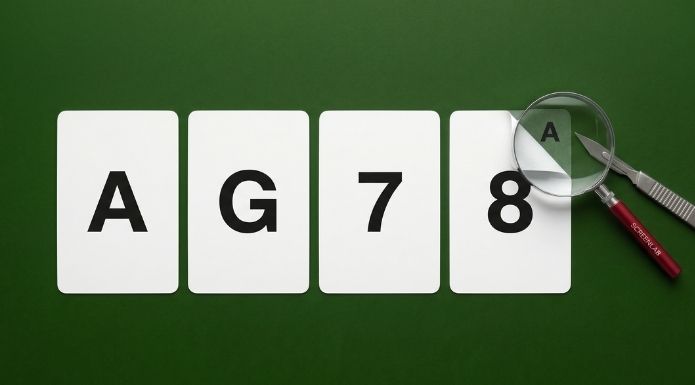
To understand the bypass, we first have to look at the mechanics being ignored. The task, as described in the video, presents a group of four cards: A, G, 7, and 8.
The Rule: “If a card has an A on one side, then it has a 7 on the other. At other times, the cards may have A on one side, and the color red on the other.
The objective is to identify only the two cards that must be flipped to determine if the rule is being followed. There is no social context, no trick phrasing, and no “hidden” psychological trap. It is a straight test of conditional logic, specifically, the ability to identify a counterexample.
The Confirmation Bias
Most people pick A and 7. While flipping A is correct (it could reveal a non-7 and break the rule), flipping 7 provides zero information. The rule doesn’t say “All 7s must have an A.” Flipping the 7 is just looking for a “win”, a confirmation that the rule exists.
To actually test the rule, you must look for the Counterexample. This means flipping the 8. If there is an A on the other side of that 8, the rule is not being followed! Yet, in abstract tests, the human brain consistently ignores the “8” because it doesn’t “feel” like it has anything to do with the rule.
The “Banter Buffer” Breakdown
In the The Reasoning Test Psychologists Still Can’t Explain specimen, the first 20 minutes are dedicated entirely to a “Banter Buffer.” This is a calculated delay where the hosts demonstrate the failure of the logic test over and over again, including a staged “fail” by one of the hosts—before actually explaining the mechanics.
- The Algorithm Trap: By stretching a 60-second logic check into a 20-minute “journey,” the creators ensure higher watch-time metrics. The “science” here is secondary to the “retention.”
- The Social Pacing: The unscripted, conversational tone acts as a buffer that prevents the audience from realizing how little information is actually being exchanged. It creates a parasocial comfort zone where the viewer feels like they’re “hanging out” with intellectuals, which lowers their critical defense against the coming foundational bypass.
The Mechanics of Failure: Why the Logic Fails
The reason most people fail the Wason Selection Task isn’t a lack of intelligence; it’s a conflict between formal logic and the mental shortcuts required for real-world survival. When the Rest Is Science video frames this as an “unsolved mystery,” they’re ignoring the well-documented heuristics that govern human decision-making.
1. The Anchoring and Attentional Bias
The moment the rule is stated—“If A, then 7”—the human brain anchors to those two specific symbols. This creates an attentional bias where we focus exclusively on the “Yes” part of the equation. We hunt for the A and the 7 because the prompt itself has framed them as the only relevant data points.
2. Authority Bias
In a lab or “test” setting, authority bias often takes over. The specimen is presented with a rule by a perceived authority (the “doctor” or the “professor”). Subconsciously, the goal becomes to confirm that the authority is playing fair, rather than setting out to “prove the doctor wrong.” We are socialized to look for the “truth” of a statement, not its falsehood.
3. The Survival Shortcut (The “Snake in the Grass”)
Solving the test requires deductive reasoning; something we rarely use. It is, in fact, a biological luxury. In a naturalistic setting, if you hear a rustle in the grass, you don’t stand still to deduct whether it’s a predator or the wind. You assume the threat and act. In other words, humans are hardwired to act first, ask question later.
Trying to “get straight to the truth” based on immediate assumptions is a survival feature. In the Wason test, we try to “get straight to the rule” by looking for confirmation. This leads us astray because the “truth” (the rule being followed) is exactly what the test isn’t asking for. It’s asking for the counterexample, the “8” that most people ignore because it doesn’t “feel” like it’s part of the rule. Life, however, is not a logic test. It is a fairly straightforward set of scenarios and patterns that we quickly learn to navigate, using those same mental shortcuts (cognitive heuristics or “rules of thumb”).
The Framing Fallacy: Truth vs. Transgression
The central irony of the The Rest Is Science specimen is its reliance on a false dichotomy: Truth-Finding vs. Social Exchange. The hosts argue that we fail the card test because we didn’t evolve for “truth,” but we pass the bar test because we evolved for “social contracts.”
However, they’re ignoring the most basic element of experimental design: The Prompt.
1. Verification vs. Falsification
In the original 1966 Wason test, the specimen is often asked to “Test if the rule is TRUE or False.” This language explicitly primes the brain for Verification. It invites the specimen to look for “A” and “7” to confirm the statement.
In contrast, the “Bar Scenario” is almost always framed as: “Find the rule-breakers.” This isn’t a different biological “mode”; it’s a different instruction. By asking the specimen to find a transgression, the tester is doing the logical heavy lifting for them. They have shifted the goal from “proving a truth” to “identifying a violation.”
2. The Invalid Comparison
The question isn’t whether human beings are better at truth-finding or social exchange. The question is whether comparing the two tests is scientifically valid. The simple answer? It is not. It may surprise you to know that psychology is not rigorously grounded in the scientific method. These tests don’t demonstration human reason but the power of suggestion. If a psychologist ever really spent a career puzzling over this “logic test,” it was a career wasted.
The “Science” Problem: The Replication Crisis
God-forbid that science should get in the way of our “scientific fun.” But, this test hits on a major nerve in the field: the Replication Crisis. Much of this “Social Exchange Theory” the hosts discuss relies on the idea that these results are universal and “baked into our DNA.”
The Variable Vacuum: The hosts treatsthe “Bar Scenario” as a smoking gun for evolutionary psychology. But they fail to audit the variables. If you tell a person to “Find the Liar,” they will find the counterexample. If you tell them to “See if this is True,” they will look for confirmation.
By ignoring the linguistic framing, the hosts are performing “Science as a Costume.” They’ve skipped the rigorous audit of the experimental prompt to get to the “exciting” part where they can talk about cavemen and social contracts and high-minded concepts like Deontic Reasoning and The Enigma of Reason. They’ve traded a simple linguistic nuance for a grand evolutionary narrative because the narrative is “better for the screen.”
The Deontic Distraction
The hosts lean heavily into Deontic Reasoning, the logic of permissions and obligations, to explain why we pass the “Bar Scenario.” They frame it as a sophisticated biological “mode” that we “switch into.”
But you don’t need a deep-seated evolutionary mechanism to explain why people can find a 12-year-old with a beer. When you are told to “Find the rule-breaker,” the tester has already defined your objective. You aren’t “reasoning” in a social vacuum; you are playing a game with a fixed goal. In this game, you have become a cop, and the rules are quite clear and simple: Investigate the transgression. Framing this artificial prompt as a window into the “soul of human social behavior” is an intellectual stretch designed to sound profound for the camera.
2. The Enigma of Reason (The Untestable Shield)
The Enigma of Reason is the ultimate “Science Costume.” It’s a theory that suggests reasoning evolved not for truth, but for winning arguments. While interesting, it is a Narrative Distortion in this context because:
- It’s Untestable: You cannot use an artificial logic test from 1966 to confirm a pet theory about how cavemen argued over mammoth meat.
- It Deserts the Specimen: By moving into these “unsolvable” theories, the hosts completely abandon the actual mechanics of the Wason test. They stop auditing the logic and start auditing their own imaginations.
The Explanatory Fallacy: Penicillin and the Science Influencer
The most dangerous trap for the science influencer is the belief that an observation is only “real” once it has been explained. They mistake their own understanding for the mechanism of the universe.
- The Penicillin Benchmark: Penicillin successfully killed bacteria long before we understood the mechanism of cell-wall inhibition. The evidence was the dead bacteria, not the explanation.
- The Influence Failure: In this specimen, the hosts treat the Wason test as a “mystery” because they aren’t satisfied with the mundane observation that humans use heuristics. They ignore the evidentiary power of sixty years of consistent results because those results lack a “clever” narrative. they’re trying to explain away a psychological fact rather than simply acknowledging its existence.
The Salience Smoke-Screen
If it ended there, ScreenLab would have a weaker case. But, no, our hosts aren’t finished with us. They end by pivoting to a “spicy little taboo question.” Specifically, they discuss a moral puzzle from Jonathan Haidt’s The Righteous Mind:
A family eats their pet dog after it is accidentally killed by a car. They cook it, no one sees them, and no one gets sick. Did they do anything morally wrong?
This is a tactical Salience Shift. By forcing the audience to examine their own morality regarding a “harmless taboo” (eating a family pet), the creators ensure that the final note is one of emotional provocation.
It is a “Moral Flashbang” designed to blind the viewer. If the last thing you hear is a shocking ethical dilemma, you are far less likely to realize that the previous fifty minutes were spent bypassing the foundational logic of a sixty-year-old test and taking much too long to explain something that can be explained in five minutes or less. It turns a failed science lesson into a successful parasocial experience. And, in fact, this entire audit can be read by the average reader in around 10 minutes.