
The Evolutionary Paradox
If you are an alien species that requires water to survive, you didn’t just appear in a vacuum; you evolved on a water-rich planet. To reach the stage of interstellar spaceflight, you must have enjoyed millions of years of biological stability. You didn’t build a warp drive while dying of thirst. By the time you are out in space gallivanting around the neighborhood, you are already an expert at resource management. You’ve mined asteroids, tapped into icy moons, and likely mastered the synthesis of basic molecules.
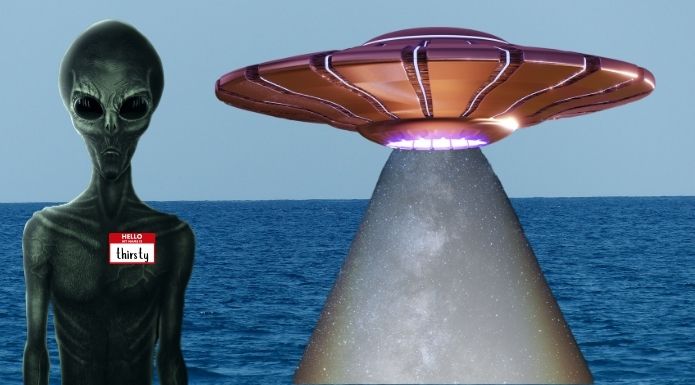
The idea that you would travel across the light-years to find a “populated” planet just to steal their water is the equivalent of a billionaire driving three states away to rob a lemonade stand because they forgot to buy groceries.
The Oblivion Self-Correction
Nowhere is this absurdity more glaring than in the 2013 film Oblivion. The story’s central conceit is that the remaining humans are being relocated to Saturn’s moon, Titan, while massive “Hydro-Rigs” strip Earth’s oceans to provide fuel for the journey.
The logic failure here is breathtaking: Titan is a previously uninhabited body that is practically made of frozen water and hydrocarbons. If you have the technology to move a population to Titan and use water as fuel, you don’t need Earth. The very existence of Titan as a viable destination proves that the invasion was unnecessary. The movie’s premise is a closed-loop paradox where the “solution” (Titan) negates the “problem” (needing Earth’s water).
The Skynet Matrix Paradox—Why Logic Doesn’t Equal a Survival Instinct – The “Tet” AI suffers from the same fundamental coding error as Skynet: it confuses objective efficiency with narrative necessity. A truly superior machine-mind wouldn’t bother with the energy-draining complexity of a human uprising when the asteroid belt offers infinite resources without the local resistance.
The “Tet” Efficiency Error
If we assume the invader is an AI (as seen in Oblivion), the failure moves from ‘stupid’ to ‘mathematically impossible.’ A machine-mind operates on a strict energy budget. The caloric/energy cost of building an occupation force, fighting a resistance, and overcoming Earth’s gravity well far exceeds the energy value of the hydrogen extracted from the water. To a machine, Earth isn’t a resource; it’s a ‘Sunk Cost.’
The Technical Redemption: Why Oblivion Still Wins the Visual Audit: While the “Tet” AI fails at basic thermodynamics, the production team behind Oblivion achieved something rare in the modern era: Avoiding the Green Screen Mud and ushering in a new visual era.
Unlike the “Grey Twilight” mud seen in many green-screen blockbusters, Oblivion used massive 15K projection screens to surround the actors with real Hawaiian cloudscapes. This ensured that the reflections on the glass furniture and the Subsurface Scattering (SSS) on the actors’ skin were physically accurate. They didn’t have to “fix it in post” because they built the light into the room.
Battle: Los Angeles—The Tactical Deficit
While the AI in Oblivion fails at basic math, the biological invaders in Battle: Los Angeles fail at basic logistics. A biological force requires “Life Form” maintenance: they need food, a breathable atmosphere, and complex medical support. By choosing to invade Earth, they’re committing to a high-gravity environment against a billions-strong local insurgency that is intimately familiar with the terrain.
If their goal is simply to extract “fuel” (water), they have chosen the most violent and expensive way to get it. It is the tactical equivalent of a military force invading a massive hornet’s nest just to steal a single glass of lukewarm tap water. In fact, we have no choice but to assume that they’re simply nasty and are driven to conquer. The “fuel” excuse becomes secondary. In other words, the writers for using “water” as a flimsy mask for a standard conquest trope.
A truly advanced interstellar species would never bother with a “Bio-Hazard” planet like Earth. They would simply drop a robotic “straw” into a comet in the Oort Cloud. Out there, the water is pure ice, the gravity is negligible, and—most importantly—no one is shooting back at you.
The “Alien-Killing Acid” Absurdity
Beyond the resource logistics, there is the common trope of water acting as a rapid, caustic acid to the invaders (most notably in Signs). This introduces a strategic blunder so massive it defies the term “intelligence.”
If your biology is so hyper-reactive to H20 that a single drop causes third-degree burns and skin sloughing, why would you choose Earth? Our atmosphere is saturated with water vapor. The grass is damp with dew. The very creatures you are trying to harvest are essentially ambulatory sacks of the stuff. Invading Earth when you are allergic to water is like a species made of gunpowder deciding to colonize the surface of the sun. It isn’t a conquest; it’s a complicated way to commit mass suicide.
The Alien Nation Salt-Water Paradox
The “Newcomers” in the classic science-fiction drama Alien Nation, both film and television show, featured aliens that were hyper-reactive to sodium chloride in water. Sea water acted as a fast-acting corrosive to them. In other words, it was like hydrochloric acid, or stronger. However, if the Newcomers were truly hyper-reactive to sodium chloride ($NaCl$), they wouldn’t just be avoiding the ocean; they’d be in a state of constant, agonizing physiological collapse just existing on Earth.
The “Sour Milk” Paradox
The Newcomers loved sour milk. It got them drunk. But biologically, milk is a mineral-rich fluid.
- The Sodium Count: Standard cow’s milk contains roughly 50mg of sodium per 100g.
- The Reaction: If sea water (which is about 3.5% salt) causes their flesh to melt like a Wicked Witch in a rainstorm, then “sour milk” isn’t a like a beer, it’s a slow-acting digestive corrosive.
Even if they have a higher tolerance for ingested sodium than topical sodium, the “Acid Water” trope in the show was often portrayed as a fast-acting chemical burn. If a splash of ocean water melts a Newcomer’s skin, a glass of milk should realistically liquefy their esophagus.
The Terrestrial Salt Problem
The Earth is very salty. Heck, we humans are very salty.
- The Atmosphere: If you live in a coastal city like Los Angeles (where the show was set), the air itself carries aerosolized sea salt. A Newcomer with that level of sensitivity would be suffering from “airborne acid burns” every time the wind blew off the Pacific.
- Human Biology: Humans are salt-based organisms. We sweat it, we cry it, and it’s in our saliva. A Newcomer couldn’t even shake hands with a sweaty human or get caught in a “sentimental” moment without needing a skin graft.
Why Alien Nation Still Works (The ScreenLab “Pass”)
Still, there are too many GREAT things about Alien Nation. In the Lab, I usually give a pass to stories where the scientific absurdity serves a high-level social purpose.
The Intent: The salt water wasn’t just a “weakness”, it was a way to keep them “trapped” on the land and segregated from certain parts of society.
The Alienness of Earth: The salt-water problem also serves to illustrate the difficulty they faced. They were on a truly ‘alien’ planet. In many “alien among us” stories, if the newcomers look like us, talk like us, and eat (mostly) like us, the “alien-ness” can get lost in the shuffle of the social metaphor.
By adding the salt-water element, the creators of Alien Nation gave the audience a visceral, physical reminder that Earth isn’t just a new home with different social rules—it is a fundamentally hostile chemical environment for them. It forces the audience to realize that while we see a beautiful ocean or a refreshing rain, they see a landscape of potential landmines.
The Audit: While the “Sour Milk” logic is a Critical Physiological Failure, we can enjoy the show by assuming their “salt allergy” is specifically tuned to the high concentrations of sodium in sea water, while their alien kidneys are somehow the most efficient sodium-scrubbers in the galaxy.
And, after all, the Newcomers didn’t end up on Earth by choice, and certainly were no invading force. To have their salt water allergy as happenstance, no matter how scientifically implausible it is forgivable compared to having them intentionally come to a plant virtually covered in water.
Why This Wouldn’t Happen Summary
Whether it’s Independence Day, Battle: Los Angeles, or Oblivion, the “resource invasion” is a Narrative Convenience used to give the humans a reason to fight back. In reality, Earth is a “Bio-Hazard” planet. We are a messy, violent, high-gravity rock. To a space-faring civilization, we aren’t a gold mine; we’re a dangerous slum that just happens to have some water in the gutter.
The “Inscrutable Alien” Counter-Argument
A common defense for these narrative failures is that “alien logic is beyond human understanding.” The idea is that an AI or an extraterrestrial species might have motives or thought processes so advanced that their decision to invade Earth for water “makes sense” to them, even if it looks stupid to us. In the ScreenLab, we counter this in two ways:
1. The Mathematical Constant
If you are traveling through space, your chief logic is Math. You may have a different base system or a different way of writing an equation, but if you are in this universe, the numbers turn out the same. The energy required to lift one ton of water out of Earth’s gravity well is a universal constant. An AI or alien race that ignores the math of “Energy In vs. Energy Out” isn’t being “inscrutable”, it’s being stupid and racing towards annihilation.
2. The “Mystery Card” Fallacy
This argument is essentially a “Get Out of Jail Free” card, similar to the theological fallback of “The Lord works in mysterious ways.” It’s a way for writers to skip a few spaces on the board and avoid logical scrutiny. In a realistic audit, “mystery” is not a valid substitute for efficiency. If an alien species behaves in a way that is objectively self-destructive and inefficient, we don’t call it “advanced logic”, we call it a failure in machine (or biological) reasoning.
The Contact Contrast
To reinforce the idea that math is a universal constant, we need only look at the “High-Quality” end of the alien contact spectrum. In films and literature that respect the audience’s intelligence, communication isn’t established through narrative convenience, it’s built on the same physics and chemistry that the invaders in Oblivion or Battle: Los Angeles seem to have forgotten.
- Contact (1997): The signal from Vega is a series of prime numbers broadcast at a frequency of “hydrogen times pi.” By combining the 1420 MHz hydrogen line with a transcendental number, the aliens aren’t just sending a greeting; they’re sending a mathematical “ID card” that proves they understand the fundamental laws of the universe. Would you expect less from Carl Sagan?
- Arrival (2016): Deciphering the Heptapod language relies on analyzing non-linear patterns and complex reasoning. It acknowledges that while biology and language might be alien, the logic required to bridge that gap must be rooted in mathematical consistency.
Ultimately, the Hydration Fallacy is a failure of intellectual curiosity. The best science fiction writers are, first and foremost, avid readers and students of the physical world. They understand that the “science” in sci-fi isn’t just a backdrop, it’s the foundation that makes the “fiction” feel earned.
In contrast, many modern Hollywood writers seem content to pitch half-baked ideas and then attempt to navigate the resulting logical mess through sheer narrative hand-waving. If these writers bothered to read the giants who came before them, those who understood that universal constants are immutable, they would be embarrassed to produce such logical schlock. You simply cannot use Hydrogen to say “Hello” across the galaxy in a story like Contact and then pretend it doesn’t exist when you need a plot-convenient invasion for a summer blockbuster.
The moment a writer tries to dress up a “Space Bully” story with pseudo-scientific justification like stealing water, they actually make the aliens look less formidable. Instead they make the aliens look like big dummies who just want to be assholes but feel they need an excuse. It turns a cosmic threat into a logistical embarrassment. Nothing wrong with a good alien conquest movie with bad-ass looking aliens and battle-hardened marines protecting the plant so, if you want to make a movie like that, just own should just own the “conquest” angle. There is something much more terrifying about an enemy that destroys you simply because they can, rather than an enemy that traveled 40 light-years because they forgot to pay the water bill.