
When you try to force a story into a pre-selected scientific label, you aren’t explaining the movie, you’re hallucinating a bias. In this audit, we examine the ‘Retrofit Fallacy,’ where the internal logic of a masterpiece like The Lord of the Rings is amputated to fit the narrow confines of a social psychology listicle.
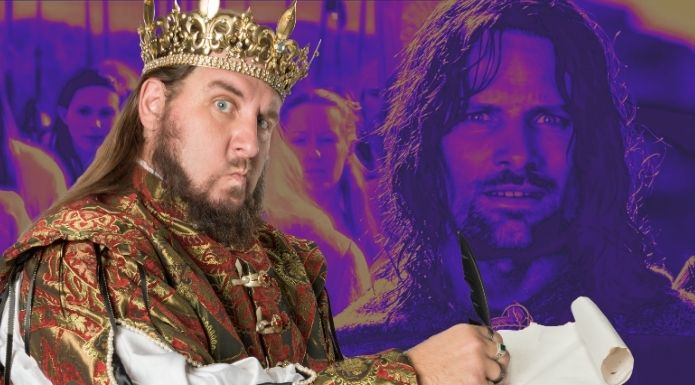
The Denethor Discrepancy
A Medium article about social psychology concepts applied to movies claims the audience dislikes Denethor because he is “unattractive” (The Halo Effect).
- The Narrative Reality: Denethor is an antagonist because he is a grieving, nihilistic leader who has been mentally enslaved by an eldritch artifact. His physical decline is a symptom, not the cause of the audience’s reaction.
- The Error: By ignoring the Palantír’s biological and psychological toll, the author isn’t explaining the movie; he’s hallucinating a bias.
The Aragorn Anomaly
The author suggests Aragorn needs “attractiveness” to be seen as worthy of kingship.
- The Narrative Reality: Aragorn’s worthiness is built on 80 years of Ranger survival, the rejection of the Ring’s temptation, and a literal bloodline mandate.
- The Error: Using the Halo Effect here is like saying people only follow a Five-Star General because he has a nice haircut. It ignores the structural infrastructure of the character.
Diagnostic: The Pinocchio Delusion. > While this audit addresses the lazy application of social labels, The Simulated Soul examines the deeper absurdity: the assumption that a collection of plot points and dialogue possesses a “psyche” to begin with. It only makes sense to analyze characters as structural entities, not as patients on a couch.
The Aragorn Audit: Competence vs. Aesthetics
If we look at the ScreenLab data, the “cool dude” factor isn’t a mystery; it’s a cumulative structural build.
The Ranger Reality: Aragorn’s appearance is a signal of Evolutionary and Skill-Based Fitness. He is a Dúnedain (long-lived) and a Ranger (physically elite). His “attractiveness” is synonymous with health, capability, and survival, data points that any rational observer (or subject) would use to identify a competent leader.
- The Skill Signal: Long before we see Aragorn in a crown, we see him at the Prancing Pony. He is alert, dangerous, and clearly possesses specialized knowledge. Skill is a massive “halo” generator.
- The Demeanor Factor: His calm under pressure (The Weathertop skirmish) and his humility (refusing the Ring) are distinct data points. A viewer doesn’t think “He’s a good king because he’s handsome”; they think “He’s a good king because he is disciplined and capable.”
- The Multispectral Positive: Aragon displays a spectrum of positive traits, leadership, empathy, tracking skills, combat prowess and, above all, loyalty. Focusing only on his face is like auditing a jet engine and only commenting on the paint job.
Appearance as Symptom, Not Bias
The Medium article argues that we judge them based on “attractiveness.” ScreenLab argues that we are observing Biological Data Points.
The Denethor Decay
- The Claim: He is “unattractive” to make us dislike him.
- The Narrative Reality: Denethor is a man suffering from Chronic Psychic Hemorrhaging. His “disheveled” state is the direct result of using the Palantír, which has effectively aged him prematurely and drained his vitality.
- The “Lifting the Spell” Moment: When that weight is finally removed, his “true strength” returns. This proves his appearance wasn’t a static “villain trait”; it was a symptom of his condition.
The Expanse Audit: Professional Labels vs. Human Kinship
The Medium article claims that Prax and Doris bonded because they “feel like they have a shared group identity of being botanists.”
The “LinkedIn” Fallacy
Sharing a profession doesn’t create an automatic “social identity” that would lead someone to risk their life in a refugee crisis. If that were true, every accountant in the world would be part of a global hive-mind.
- The Narrative Reality: Their bond is Interpersonal, not Categorical. They aren’t “Botanist A” and “Botanist B”; they’re two individuals who have worked side-by-side in the trenches of Ganymede’s agricultural collapse. The author is confusing a shared interest with a shared identity.
The “Inners” vs. “Belters” Erasure
The author mentions the Inners wrecking Ganymede but ignores that the “Belter Life First” sentiment is a response to Systemic Trauma, not just a “pre-existing prejudice.”
- The Error: By framing it as a simple “social identity” conflict, he ignores the Physics of the Setting. In The Expanse, your “identity” is literally tied to the air you breathe and the gravity that shaped your bones. It’s a structural reality, not a psychological preference.
The Diagnostic: Categorical Overreach. > Humans bond over shared experiences and trust, not because they have the same job title on their resumes. To suggest they want to stay together purely because they both study plants is to ignore the entire emotional core of the series. This is a lesson in why we don’t fit our theories to the evidence. and ignore the complex nuts and bolts of friendship in favor of a simplistic psychological label.
Star Wars: The Tautology of ‘Attitude’
The Medium author reduces the fall of the Galactic Republic to a lesson in “Attitude Structure.”
The ScreenLab Response: Labeling the murder of “younglings” as a catalyst for “attitude change” is comically insufficient. While a real psychological audit might look at Specific vs. General Attitudes in high-stress relationships, the author settles for observing that the characters “felt things” and calling it an evaluation.
The Granularity Gap
The article frames the scene on Mustafar as a shift in Padmé’s attitude toward Anakin. But to understand why she behaves the way she does (backing away, refusing to join him), we have to look at the hierarchy of her attitudes.
1. General Attitude: “I Love Anakin”
This is the broad, “Protect the Planet” level of attitude. It’s what kept her in the marriage despite the red flags. If we only looked at this, her behavior should be to stay by his side no matter what.
2. Specific Attitude: “I cannot support the murder of children/dictatorship”
This is the “Recycling is a pain” level, except in reverse. This is a specific, high-intensity attitude toward a concrete action Anakin has just taken.
The Behavioral Predictor:
When these two clash, the Specific Attitude wins every time.
- The Failure of the Medium Analysis: The author treats it as a general “attitude change.”
- The ScreenLab Analyses: Padmé hasn’t necessarily stopped “loving” the man (General), but she has developed a non-negotiable Specific Attitude toward his current state. Her behavior, withdrawing and weeping, is a direct result of the specific data point (the “Younglings”) overriding the general data point (the marriage). Thinks of, perhaps, loving your brother but not being able to accept his politics, so you choose to stay away from him. These are not “conflicting” attitudes. Instead, they reflect a hierarchy of attitudes.
Or, think of it like this: You can love puppies without being an activist, out in the field, protesting puppy mills.
The ScreenLab Reality: The Narrative Puppet
Let’s be honest: Anakin Skywalker is a puppet on a narrative string. We can talk about “General vs. Specific Attitudes” all day, but the truth is that he suffers from what director Sidney Lumet called the “rubber-ducky” school of screenwriting. The theory goes: “Someone once took his rubber ducky away from him, and that’s why he’s a deranged killer.”
In Anakin’s case, the “ducky” is his mother, or his fear for Padmé. The script ignores his actual psychological gears because it needs him to be a “deranged killer” by the third act. He isn’t a person with a psyche; he’s a structural requirement of a prequel.
Further Reading
- The Simulated Soul and the Rick Grimes Paradox — The definitive counter-argument to “couching” fictional characters. If they don’t have a soul, they can’t have a “Social Identity.”
- The Infiltration Paradox: Machine Logic vs. Movie Logic — A study in how “Movie Logic” ignores the physical weight of a machine (The Terminator) just as listicles ignore the weight of a narrative.
- The DNA Undo Button: Why Evolution Isn’t a Rewind Feature — Another example of why “Undo” isn’t a biological or narrative reality. You can’t un-mutate a genome any more than you can un-ring the Palantír’s bell.
- The Disheveled Cheat: Why Bugonia’s Alien Twist Feels Fake — ScreenLab audits Yorgos Lanthimos’ Bugonia, exposing how the film uses visual class bias, beekeeping tropes, & narrative clutter to hide a cheap sci-fi gimmick.
- Groovy Bionic Limbs: The Kinetic Anchor Failure Sci-Fi Audit: Why Bucky Barnes and the Six-Million Dollar Man would be a robot with a human brain.