
There is a common, modern delusion that the science in fiction is merely a backdrop, a set of interesting premises used to explore the “real” human story. This view is not only lazy; it’s a fundamental misunderstanding of the genre. If a writer can take their sci-fi story, move it to a 19th-century logging camp, and keep every character beat and structural challenge intact, they aren’t writing science fiction. They’re using science to dress up a story that does not hinge on the science.
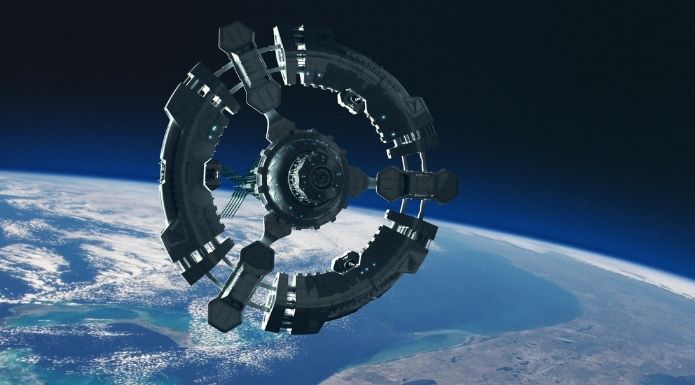
The Dual Specimen Strategy
To illustrate why the “Sci-Fi Prop Fallacy” is an inaccurate view of Science Fiction, I’m auditing two novels/films that approach scientific integration from opposite ends of the spectrum:
- 2001: A Space Odyssey (1968): The gold standard for Hardware and Physics. It’s a film that prioritizes the nuts and bolts of the vacuum and the machine, often at the expense of traditional character warmth. Here, the physics are the drama.
- Enemy Mine (1985): A masterpiece of Sociological and Biological Integration. While it takes some liberties with its astrophysics, it builds a flawless foundation out of alien culture, language, and reproductive biology. It proves that a “human” story is only as strong as the world-building it stands on.
By analyzing these two together, we can see that true science fiction isn’t about getting every single decimal point right, it’s about choosing which aspects to tighten so that the story can actually hold weight.
When science is truly used as a prop in Sci Fi, as nothing more than a cool idea to get the story moving, the result is watered-down, “science fantasy” logic where rules are ignored the moment they become inconvenient for the plot.
The Three-Body Evolution Fraud: The Dehydration Adaptation Myth — Why the Three-Body Problem’s aliens are a biological impossibility hidden behind the vastness of high-concept physics.
2001: A Simultaneous Blueprint
There is a myth that the 1968 Stanley Kubrick film, 2001: A Space Odyssey, was a “loose adaptation” of an existing book by Arthur C. Clarke. Because of this, most modern critiques of 2001 treat it as a visual artifact. Instead, Clarke co-wrote the screenplay and the novel simultaneously, based on his previous short stories, especially “The Sentinel.” This process and collaboration with Kubrick spanned four years, beginning in 1964. Much of the dialogue, however, was later removed by Kubrick, who focused heavily on the visuals.
The departure from what people found in the book is probably the reason so few understand that the film was very much built on a foundation provided by Arthur C. Clarke, a man who literally invented the concept of the geostationary communications satellite. The film didn’t just ‘stumble’ into accuracy; it was a deliberate forecast based on Clarke’s dual role as a novelist and a scientist.
For younger readers, it’s vital to remember that 2001 was set in a “far-off future” relative to its creation. It was a serious exploration of speculative science based on the trajectories of the 1960s. To judge its “inaccuracies” against the International Space Station (ISS) is a fundamental category error. This wasn’t a documentary on 21st-century space stations; it was a faithful forecast of what could be, built on the nuts and bolts of Arthur C. Clarke’s true scientific background.
The 1968 Horizon: The Velcro Grip Shoe Fallacy
People often nitpick the “grip shoes” in 2001 because they don’t match the International Space Station (ISS) reality of today. they’re missing the point. Clarke and Kubrick weren’t filming a documentary; they were forecasting an imagined future.
- Accuracy: They spent their imagination budget on the biological reality of a 10-second vacuum window and the physics of the Discovery One’s centrifuge.
- Logic: The shoes used to get around in the zero-gravity environments weren’t a “mistake”, they were a speculative choice for commercial space travel. The science wasn’t a prop; it was the blueprint.
The Vacuum Window: 15 Seconds of Useful Consciousness
The most common myth about space is that it’s an “instant-kill” zone. Pop culture has taught us that you either turn into a human popsicle or expand until you burst. Neither is true. In reality, a human has a window of roughly 10 to 15 seconds of “useful consciousness” in a vacuum.
1. The “Exploding Lung” Error
People who think they’re “too smart” for 2001: A Space Odyssey often gripe that Bowman should have exploded. they’re half-right, but for the wrong reason.
- The Physics: If you hold your breath, the air in your lungs expands violently as the external pressure drops to zero. This would cause your lungs to rupture (explosive decompression).
- The Bowman Audit: If you watch the scene closely, Dave Bowman doesn’t hold his breath. He takes a deep breath and exhales completely before blowing the hatch. He is purposely oxygenating his blood and then expelling as much air from his lungs as possible. Then, he is operating on the residual oxygen already in his bloodstream. Score 1 for accuracy.
2. The Freeze Instantly with Boiling Blood Myth
Your blood doesn’t boil instantly, and you don’t freeze solid (vacuum is actually an insulator, not a conductor). Your primary limit is the oxygen-depletion timeline. Once the pressure drops, the oxygen in your blood begins to move in reverse, out of your blood and into your lungs to be exhaled. You have about 15 seconds before that deoxygenated blood hits your brain and “turns out the lights.” Bowman’s transit was a 10-second sprint. It wasn’t magic; it was tight biological math.
Diagnostic: The Ocular Integrity Myth
The “Pop” Fallacy: Pop culture loves the ‘popping eyes’ in space visual, but your eyes are not popcorn kernels. It’s a physical impossibility for your eyes to “pop out” in a vacuum. The eye is a tough, fibrous sphere filled with non-compressible fluid (vitreous humor), held in place by powerful extraocular muscles and a bony socket. There is no biological mechanism that would cause them to eject.
- The Reality of Swelling: While your soft tissues would eventually begin to bloat (ebullism) as water vapor forms in your cells, this is a process of minutes, not seconds. Your eyes would not swell up like balloons in the time it takes to fly across an airlock.
- The “Lid Lock”: To be extra sure nothing would happen to your eyes, should you find yourself in an evacuated airlock, you should close your eyes very tightly. No, your eyelids are not a replacement for a pressure suit, but they protect the cornea from the immediate, violent evaporation of your tear film. Without the lids, your tears would boil off instantly, a sensation that would feel like freezing sand being rubbed into your pupils. Not pleasant, but also not deadly.
The 2001 Communication Audit: Editing the Lag
People complain that the “instant communication from near Jupiter to Earth in 2001 is inaccurate. However, the film didn’t ignore the speed of light; it built the narrative around it.
1. The “BBC Interview” Diagnostic
Early in the film, when the crew is interviewed by the BBC, the announcer explicitly mentions that the interview was conducted with a significant time delay and then edited for the broadcast.
- The Physics: At Jupiter’s distance, a radio signal takes roughly 33 to 52 minutes to reach Earth (depending on orbital positions). A two-way “hello” would take over an hour.
- The Narrative Solution: Instead of a ignoring these significant delays, the film uses HAL 9000 as the buffer. HAL isn’t just an autopilot; he is the communications manager. He records the crew’s messages, transmits them, and then plays back the Earth-side responses when they arrive, creating the illusion of a conversation for the viewer while the script acknowledges the reality of the void.
2. The “Birthday Message” Reality
When Dave watches a birthday message from his parents, it’s clearly a pre-recorded packet. There is no “Live FaceTime” in the ScreenLab’s version of 2001.
- The Integration: This isn’t just “accurate science”, it’s a character tool. The lag emphasizes the isolation of the crew. They aren’t skyping home; they’re receiving digital letters from a world they left months ago.
3. The Linear Acceleration Error
- The Gripe: “It’s 2026 and we still don’t have a sentient AI that can play chess perfectly, lip-read, and experience a existential crisis like HAL.”
- The Let’s Not Be Ridiculous Reality: Clarke and Kubrick were extrapolating from a period where technology was advancing at a breakneck, visible pace. In 1968, the moon landing was a year away. If you follow that line on a graph, the idea of a sentient computer by 2001 isn’t “wrong”, it’s a logical, optimistic projection.
- The Miniaturization Blind Spot: Clarke and Kubrick foresaw the complexity of AI, but like almost everyone in 1968, they assumed a computer that smart would still need to be the size of a room. They missed the Moore’s Law trajectory where computing power wouldn’t just grow, it would collapse in size.
- The Scale Shift: In 1968, more power equaled more mass. HAL is the size of a room because the logic of the time dictated that a sentient brain would require miles of wiring and thousands of vacuum tubes or early transistors. HAL is a massive, centralized mainframe because, in 1968, more power meant more hardware, not smaller transistors.
- The “Flying Car” Factor: Before you go complaining that they got HAL wrong, note that we were also “promised” flying cars and robotic servants by the 21st century. Science fiction isn’t a time machine; it’s a mirror of current momentum. To criticize HAL for being “too smart” is to criticize the film for having an imagination.
4. The Miniaturization Paradox
- The Atomic Wall: Everyone missed that computing power would go Internal. Instead of building a computer the size of a building (which would have been a thermal and logistical nightmare), we began cramming billions of transistors onto a sliver of silicon.
- The “No Free Lunch” Reality: We traded the Giant AI for Infinite Distribution. We don’t have a singular HAL running the ship; we have thousands of micro-processors running everything from the toaster to the life support. However, as we approach atomic-level transistor sizes, we are hitting a physical limit that Clarke’s linear projection never had to account for.
Production Constraints vs. Scientific Accuracy
Many of the modern complaints about the inaccuracy of 2001: A Space Odyssey are pedantic failures to distinguish between scientific ignorance and practical filmmaking limits.
1. The Gravity Gait: Earth-Normal on the Moon
Critics gripe that actors on the Moon move with Earth-normal gait instead of the 1/6th gravity “hop.”
- The Practical Trade-Off: In 1968, pulling off a realistic low-gravity walk required wire-work that often looked “floaty” and more “fake” than just walking normally. Kubrick chose visual grounding over a distractingly poor effect. Even today, using wires to pull this off looks fake as all get out.
Why Wires Fail For Moon Walking
The Pendulum Problem: Wires pull from the harness, which means when an actor “leaps,” their limbs don’t move with the natural ballistic trajectory of 1/6th gravity. Instead, they look like they’re being hoisted. It creates a floaty look that screams “stage play.”
The Tension Give-Away: You can always see the lack of weight in the feet. In real lunar gravity, you still have mass and inertia; you just have less weight. Wire-work often makes actors look weightless, which is a different physical state entirely.
The “Grounding” Choice: By having the actors walk with a purposeful, heavy gait, Kubrick maintained a sense of Physical Presence. It’s better to have a slightly “heavy” walk on the moon than to have a high-tech “float” that constantly reminds the audience they’re watching a set.
2. The Lunar Dust Billow
When the Aries 1B lands, the dust billows in “clouds”, a behavior only possible in an atmosphere. In a vacuum, dust moves in ballistic sheets.
- The Diagnostic: Again, how do you simulate a vacuum dust-kick in 1968? You can’t. This is a Prop Constraint, not a failure of Arthur C. Clarke’s physics. It’s better to let the dust billow up then have a comical looking “dust in a vacuum effect” that looks like it was made out of the same stuff they made the tornado from in Wizard of Ozz.
3. The Atrophy Oversight
The film ignores the severe muscle atrophy and bone density loss associated with long-term zero-G.
- The Historic Reality: Filmmakers are not Gods. The full scope of zero-G’s toll on the human body only became clear after decades of data from the International Space Station. At the time the film was made, this was emerging science. Even if they had guessed it, showing the crew in a state of constant physical decay would have been a different movie entirely.
The Science Fiction Pivot: From Hardware to Heart
While 2001: A Space Odyssey stands as the gold standard for Physics-First integration, it famously leaves the human element as cold as the void itself. Arthur C. Clarke could calculate a trajectory to Jupiter with surgical precision, but he struggled to draft characters that felt like more than biological extensions of the ship’s controls.
This is where we pivot to Enemy Mine. If 2001 is an story of the vacuum, Enemy Mine is a story of the human soul.
Diagnostic: The Structural Necessity of the Drac
To the untrained eye, the scientific inaccuracies of Enemy Mine, the atmospheric meteor storms, the questionable planetary geology, look like the “prop” logic we just condemned. But look closer at the Drac biology and sociology.
In a “Prop” story, the alien’s biology would change the moment the script needed a twist. In Enemy Mine, the parthenogenesis and the cultural weight of the Talman are the very things that drive the plot into its most difficult, inconvenient, and emotional corners. The science here isn’t a “cool idea” to get the story moving; it’s the Foundational Law that forces the characters to evolve.
Longyear didn’t ignore science; he chose a different set of nuts and bolts to tighten. He traded astrophysical accuracy for biological and sociological “heart.” Let’s be honest, he wasn’t writing Dune. He understood that to make every single scientific and sociological detail “perfect” would require 300 pages of mind-numbing drudgery. He prioritized the Integrated Soul of his characters over an exhaustive manual of their world. Let’s label this Speculative Efficiency. He gave us exactly enough science to make the story ground-breaking, without burying the reader in the data.
As it is, Enemy Mine comes with an appendix explaining the Drac language. Longyear didn’t rely on the ‘Herbert Shortcut’ of borrowing from existing Earth languages to imply historic depth. He built the Drac language from scratch, a painstaking commitment to originality that ensures the alien culture never feels like a retrofit of our own history. The film version added specific guttural sounds and words that were basically Russian pronounced in advance.
The “Logging Camp” Fallacy
But let’s explore Enemy Mine objectively. Critics of “soft” sci-fi might ask a similar question to the one I started with: “Could this have just been set in an 18th-century logging camp?” For Enemy Mine, the answer is a resounding No.
- The New Horizon: To explore the deep, abiding, and familial bond between Davidge and Jerry, Longyear needed to strip away every shred of terrestrial baggage. He wasn’t just creating a survival story; he was building a new culture from the ground up.
- The Speculative Necessity: You can’t achieve that kind of total reset on Earth. By placing two enemy combatants on the hostile world of Fyrine IV, the story uses a speculative story of Alien Sociology to prove that shared struggle doesn’t just create a bond, it rewires the very definition of “Human.”
Diagnostic: The Character Trade-Off
- The 2001 Sacrifice: Kubrick and Clarke traded character depth for absolute Scientific Mastery (within limits).
- The Enemy Mine Sacrifice: Longyear traded Astrophysical Accuracy (the “Atmospheric Veneer” of meteor storms and questionable geology) for Psychological Realism.
One gave us a ship that felt real; the other gave us a friendship that felt real. ScreenLab Opinion: Both are valid foundations, provided the writer knows exactly which nuts and bolts they’re tightening. Not many readers are truly jumping out of their chairs and complaining about the implausibility of the meteor showers in Enemy Mine, they’re too caught up in the growing bond between the characters. But let’s look at some of the principal complaints about Jerry (the Drac) and the Dracs in general.
The Drac Audit: Parthenogenesis and Biological Integrity
Critics who say we don’t see asexual reproduction in multicellular animals are suffering from a lack of research. While the Dracs are certainly a “convenience” in terms of their humanoid-reptilian appearance (the classic “budget-friendly alien” trope), their reproductive cycle is one of the most grounded parts of their biology.
1. The “Earth Reality” Diagnostic
To say asexual reproduction is “unrealistic” for a multicellular organism is simply false.
- The Earth Reality: We see this on Earth in a process called parthenogenesis. It occurs in various complex, multicellular animals, including certain species of lizards, snakes, sharks, and even birds, as well as crustaceans.
- The Komodo Dragon Standard: Female Komodo dragons have been documented producing offspring without mating. If a 150-pound apex predator on Earth can do it, why is it “unrealistic” for a Drac on Vissith?
The Budget-Friendly Alien
The ScreenLab is as tired as anyone else of lazy humanoid alien effects. The mostly human with a weird nose (or forehead) trope has little to recommend it. But, few science fiction stories offer a glimpse of an alien so richly imagined. In fact, most science fiction stories that do feature truly “alien” extra-terrestrials are cold and stilted, trading “shape” for depth.
- The Much-Maligned Humanoid Alien : Yes, the Dracs are humanoid with reptilian skin, a design that is friendly to both a film’s makeup and effects budget and the reader’s imagination.
- The Narrative Trade-off: Longyear and the filmmakers chose to spend their “imagination budget” on the Deep Integration of the Drac culture, language, and reproductive cycle.
- The Original Alien Reality: Truly “alien” physiology often requires endless exposition to make it readable. By choosing a recognizable shape, the author could dive straight into the Psychological Realism of the two characters. The science wasn’t a prop; it was a specific choice to prioritize the social and biological over endless exposition about an alien’s shape and physiology.
Let’s look at what often happens when “original” aliens are attempted.
The “Cold Calculator” Diagnostic
Ender’s Game Failure: The Buggers of Ender’s Game are a tired “Hive Mind” prop. By making them an insectoid collective, the narrative removes their individual agency. They don’t have “souls” like Jerry the Drac, they have a biological directive. It makes them a wall for the protagonist to run into, and nothing more.
The Arrival Paradox: Even with the high-concept linguistic depth of Arrival, an excellent movie, the heptapods remain “Otherworldly Cold.” The film spends its “Imagination Budget” on the physics of their language (non-linear time), which leaves very little room for the Psychological Realism of the aliens themselves. they’re majestic, but they aren’t “real” in the way Jerry is.
The Time Constraint: A 100,000-word novel or a 120-minute film simply doesn’t have the bandwidth to explain a non-Euclidean biology and build a character driven, fully realized story that involves a relationship between Earthlings and Alien. In other words, for Enemy Mine to exist in the way some critics would like it to exist, would create book and film that could not be recognized as having the same DNA.
To sum it up, most stories that feature truly ‘alien’ extra-terrestrials are cold and stilted, trading ‘shape’ for emotional depth. If the alien is fully realized, the story becomes a ‘Handbook of the Alien’ where the word budget is spend on shape, physiology, etc. and the creature itself is a cold calculator, not much different than a malfunctioning AI. The trade-off in Enemy Mine wasn’t a failure of imagination; it was a necessity. Longyear chose to give Jerry a soul instead of a thirteenth tentacle.
The Drac Language Budget
The Vocal Shortcut: Using mouth shapes and vocal cords for a Drac is a “budget” choice, but a narrative necessity.
Integrated Payoff: Because they share a similar communication medium (sound), the novel and later the film can explore the deep, soulful nuances of the Talman—the Drac holy book—and the shared lineage of their ancestors.
The Rewarding Trade-off: A truly alien communication method (e.g., non-vocal) would have made the slow, emotional building of their bond almost impossible to track for an audience. It proves that the best sci-fi doesn’t try to be “alien” just for the sake of it; it uses science to build a bridge to the human element.
Integration vs. Originality
- Kubrick/Clarke spent their budget on Physics, not Psychology, Atrophy, and Bone Demineralization.
- Longyear/Petersen spent their budget on Sociology and Biology.
In both cases, they didn’t try to be “Science Gods” of every single discipline. They mastered the ones that served the Foundation of their specific story.
To choose a truly original alien shape for Enemy Mine might have made for an unreadable book. Enemy Mine is a masterclass in prioritizing the foundation that matters: the shared survival and biological reality of the Drac, rather than getting lost in the aesthetics of the ‘Alien’ label. On the other hand, hours long conversations between HAL and bowman would have stopped 2001 in its tracks.
We can see the difference when that narrative budget gets flipped by looking at The Murderbot Diaries. Because Martha Wells isn’t spending pages on the “Hardware Foundation” (we already accept they’re high-tech constructs), she can spend the entire narrative budget on the Psychological Realism of their banter.
Difference in Intent: HAL is a centralized, “cold” mainframe meant to facilitate the physics of a mission. The narrative budget in 2001 was spent on the Vacuum; long chats would have broken the atmosphere of isolation. Furthermore, HAL had no need to be chatty as it wasn’t necessary to his function.
The Murderbot Chats: Murderbot’s “Humanity” comes from its social anxiety and its relationship with other systems, such as its friend ART, (Asshole Research Transport). Wells isn’t spending pages on the “Hardware Foundation” (we already accept they’re high-tech constructs). Therefore, she can spend the entire narrative budget on the Psychological Realism of their banter. The long conversations don’t only work, the are the foundation.
Final Audit Verdict: The Storytelling Standard
Too often, argumentative conversations about “what is science fiction” lose sight of the most important question: Is it good storytelling? Science Fiction has the same restraints and considerations as any other narrative form. What we’ve shown here is that good storytelling in Sci-Fi can take vastly different forms, from the hardware-heavy forecasting of Clarke to the sociological heart of Longyear, and still fall firmly under the Sci-Fi umbrella.
In the ScreenLab, I don’t audit for “accuracy” just to be pedantic. I’m looking for Integration. Whether the foundation is built of silicon or soul, the only thing that matters is that it holds together strong.
Some Files From Under the Lab Bench
- The Trisolaran Stability Paradox: Infinite Improbability of 3-Body Adaptation — Why the Three-Body Problem’s aliens are a biological impossibility hidden behind the vastness of high-concept physics.
- The Lord of the Flies Fallacy—Why the ‘Savage’ Genre is a Psychological Fraud — Dismantling the Lord of the Flies Fallacy and the myth of the “instant savage.”
- The Murderbot Logic—A Study in Empirical Excellence — Why Murderbot is the gold standard for integrated synthetic sentience.