
The premise of Mickey 17 (and the novel Mickey 7) is built on an absurdist premise: In the harsh environment of an ice-planet colony, one man is designated as “expendable.” He is a clone whose job is to die in place of everyone else. If he falls into a crevasse or gets eaten by an indigenous lifeform, the colony simply “re-prints” him from his last backup. The movie wants you to feel bad for Mickey. It wants you to see him as the lowest rung on the social ladder, a disposable piece of cloned trash.
But if you perform a quick inventory of the colony’s resources, the joke reveals itself. On a frozen wasteland where every watt of power is a life-or-death calculation, Mickey isn’t the most “disposable” person there. He is, quite literally, the most precious and expensive resource in the colony, if not the galaxy.
The Old-Fashioned Colonist vs. The Industrial Spike
To understand why Mickey is the most expensive person on Niflheim, you have to look at the colony’s energy ledger.
The Gestated Colonists: Most of the crew arrived the old-fashioned way. Their gestation, birth, and early development are “costs” that happened before they ever stepped foot on the ice planet. The colony isn’t paying for their creation; they’re only paying for their maintenance (transport and food).
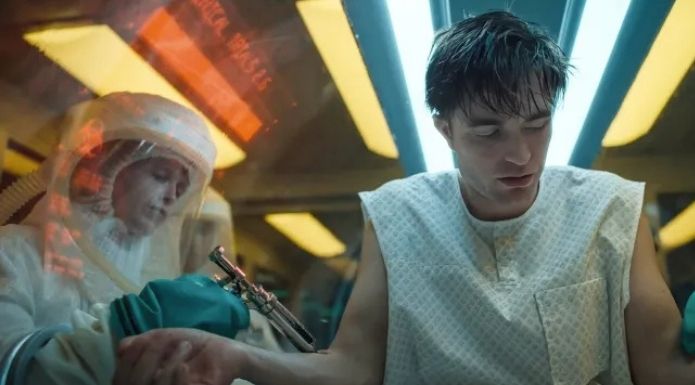
The Mickey Protocol: Mickey is a recurring industrial event. Every time he is re-printed, the colony has to divert a massive spike of energy into the molecular assembler. They aren’t just feeding a worker; they’re manufacturing one from scratch using the colony’s limited power grid.
The Kinetic Anchor Failure: While Mickey 17 ignores the thermodynamic cost of “printing” a body, many other sci-fi staples ignore the structural cost of upgrading one. If you think a colony can’t afford to print a Mickey, wait until you see why Bucky Barnes should realistically shred his own shoulder every time he throws a punch.
Read the Audit: Groovy Bionic Limbs: The Kinetic Anchor Failure
The Thermodynamic Reality
As I noted in the Physics of Rapid Healing, assembling biological matter is not a clean or cheap process. To build 180lbs of bone, muscle, and neural pathways in a short window requires a localized energy surge that would likely dim the lights in the rest of the habitat.
The narrative wants us to see Mickey as “expendable” because he can be replaced. But in a closed-loop system where every watt of power is a life-or-death calculation, replacing him is the most expensive thing the colony can possibly do. In a rational colony, sending Mickey into a dangerous hole is the equivalent of using a bespoke, 3D-printed titanium surgical robot to prop open a door.
The Efficiency Myth: Why “Atomic Reversion” is a Scam
The film relies on the visual of Mickey being tossed into a high-energy “plasma pit” to be reverted to raw materials. The story assumes this is a 1:1 transaction, matter in, matter out. But recycling biological matter in this way has a steep entry fee.
- The Entropy Tax: Even with inert materials like plastic or aluminum, you cannot recycle with 100% efficiency. You lose material to oxidation, slag, and chemical breakdown. To do this with biological matter, complex proteins, lipids, and neural architecture, requires an industrial energy input that would make a steel mill look like a toaster.
- The Plasma Paradox: If the colony has the energy to power a plasma deconstructor that can atomize 180 lbs of organic matter on demand, they have enough energy to automate the entire colony. They have reached a level of power generation where “manual labor” is a hobby, not a necessity.
Plasma Gasification In the Real World
The film treats the “plasma pit” as a clean, 1:1 recycling chute, but real-world plasma arc waste disposal proves the opposite. In industrial gasification, subjecting mass to temperatures over 3,000°C does not neatly reclaim complex proteins or skeletal structures; it reduces matter to a chaotic soup of syngas and vitrified slag. To break a human asset down to its elemental components requires an immense energy investment, and rebuilding those raw elements back into organized, complex biological tissue incurs a penalty a colony could never pay.
The Vaporization Cost: To take 180 lbs of highly organized biological mass (which is roughly 60% water, mind you) and subject it to plasma temperatures exceeding 3,000°C to snap every atomic bond requires roughly 250 to 300 megajoules (MJ) of raw thermal energy just for the destruction phase.
The Endothermic Penalty (The Real Debt): Re-assembling those unbonded, chaotic atoms back into complex proteins, cell walls, and neural pathways is a massive endothermic (energy-absorbing) process. Because of the Entropy Tax, forcing those elements back into a highly complex, low-entropy state takes many times the energy it took to break them down.
The Real Cost: Even assuming a highly advanced, ultra-efficient future 3D molecular printer operates at an incredibly generous 10% thermodynamic efficiency (which is vastly superior to any biological cell growth or modern synthetic peptide synthesis), it scales the energy requirement massively. Reprinting a body would require on the order of 2,500 to 3,000 megajoules (MJ) of continuous, highly structured energy. Add that to the initial energy cost of destroying the matter, which is always easier than putting it back together, and we have an energy expenditure as high as 3,300 megajoules.
The colony of Mickey 17 is an impossible dream: The energy required both to vaporize the worker and to manufacture the replacement is enough to build a fleet of robots and run them not for weeks or month, but for years. Such an advanced future colony could channel that energy into charging a fleet efficient, industrial-grade automation units running on rugged, solid-state batterie or a small nuclear-decay cell common sci-fi space environments.
Splitting that single, massive “Mickey Print/Vaporize Cycle” surge across a fleet of 5 to 10 localized robots means each unit isn’t just powered for a few shifts but for thousands of operational hours. A standard industrial automated drone or treaded rover pulling a continuous 250 to 500 watts of power to perform basic clearing, digging, or maintenance tasks would only consume about 20 to 40 MJ per day. You could run over 80 of these for an entire day for the cost of one Mickey cycle. A fleet of 10 would probably be more than enough for a small colony.
The Overwhelming Absurdity of Printing a Mickey
As you can see, the premise is absurd. If you have the energy to “print” a Mickey, you have the energy to build a Tungsten-Carbide Robot that doesn’t need air, doesn’t need food, and doesn’t “die” when it falls into a hole.
By choosing to print a biological human, the colony is opting for the most fragile, high-maintenance, and energy-inefficient tool possible. It’s like using a hand-carved mahogany spoon to dig a trench when you have a fleet of excavators parked in the garage. They’re manufacturing a Luxury Liability and calling it an “Expendable.” Everyone else is a “stock model”; Mickey is a custom-built, energy-intensive luxury item. The irony is that the “expendable” clone should be the one person the colony cannot afford to lose.
The Robotic Paradox: Why Build a Fragile Worker?
The absence of such purpose-built automation is, then, most glaring plot bypass in Mickey 17. To create a “Mickey,” the colony must digitize a consciousness and print a biological body, two feats of engineering that imply they have already solved every technological hurdle in existence. If you have the technology to print a functional human eye, you have the technology to build a high-resolution optical sensor. If you can print a human femur, you can forge a carbon-fiber support strut.
This stands in stark contrast to the grounded realism we see in the original RoboCop (1987). In that classic, the technology is a desperate attempt to bridge the gap between a biological brain and a machine chassis, leading to “Somatic Rejection.” In Mickey 17, the colony has the technology to build the perfect machine, yet they choose to print a heat-leaking, oxygen-dependent, bipedal human frame.
The Verdict: Printing a human to do manual labor in a high-tech colony is a Foundational Negligence. It’s like using an abacus to replace a super-computer. The story forces a biological solution onto a problem that their own technology has already made obsolete.
The “Bipedal” Fallacy
The colony claims they need Mickey for “dangerous work,” yet they insist on giving him the most inefficient form factor for an ice planet: a bipedal, heat-leaking, oxygen-dependent biological frame.
A worker robot doesn’t need to look like Mickey. It doesn’t need a digestive tract, a nervous system that feels pain, or a psyche that gets bored. It needs treads for the ice, a nuclear battery for the cold, and a chassis that doesn’t shatter when it falls.
Mickey as a “Sentimental” Luxury
The only logical conclusion is that the Mickey program isn’t about labor at all. It’s a Gilded Fetish. The colony is spending an astronomical amount of energy to maintain the idea of a human worker, even though a $500 drone would be more effective. Mickey isn’t the bottom of the social ladder; he is a high-maintenance, energy-sucking artifact of a civilization that has forgotten how to be practical.
The Empathy Void: Why the Audience Doesn’t Care
The ultimate failure of Mickey 17 isn’t just the Thermodynamic Debt; it’s the Biological Devaluation of the protagonist.
Human empathy is a survival-based mechanism. We are evolutionarily wired to care about other living beings when there are permanent consequences to what happens to them. When a film tells you a character is “expendable” and proves it every twenty minutes by printing a fresh one, it short-circuits the audience’s ability to invest.
The “Save-Game” Syndrome
By making death a temporary industrial inconvenience, the filmmakers have stripped the story of all biological stakes. Mickey becomes a video game character with infinite lives.
- The ScreenLab Puncture: If the colony doesn’t value Mickey because he’s a Luxury Liability, and the narrative doesn’t value him because he’s a punchline, the audience cannot value him with their empathy.
This is the “Disposable Human” trap. In trying to make a “social point” about corporate greed, the authors made a character so literally disposable that he becomes boring. We don’t watch a printer and worry if it’s going to run out of ink; we just wait for the next page. Mickey 17 is that printer, and the audience has no reason to care about the paper.