
The “Self-Aware Fish” has officially gone viral. If you’ve spent any time in the science corners of YouTube or social media lately, you’ve likely seen headlines claiming that the Cleaner Wrasse has shattered our understanding of animal consciousness. The catalyst is a series of fascinating studies by Professor Masanori Kohda that seemingly show these tiny fish passing the “Mirror Test”, the gold standard for self-recognition.
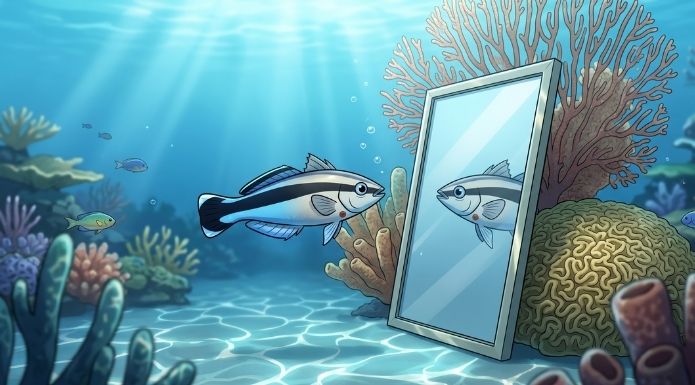
Naturally, the digital reporting on this has reached terminal velocity. High-profile science communicators like A Curious Birb and Anton Petrov have used these studies to suggest we are on the verge of a “Scientific Confirmation of Consciousness.”
While Kohda’s methodology shows brilliant experimental design, the viral interpretation of his work is a blatant case of Anthropomorphic Drift. It’s a massive logical glide where a specific biological reflex is being misinterpreted as a philosophical awakening. To understand how we got here, we have to look at the ground zero of testing for self awareness.
The Turing Test as Ground Zero
The misconception that consciousness can be confirmed via a simple, binary test likely began with the Turing Test. Designed as a measure of a machine’s ability to “imitate” human response, the Turing Test was never meant to be a sentience detector. However, it established a cultural precedent: if an entity passes a specific “ritual,” we bestow upon it the crown of consciousness.
The Mirror Self-Recognition (MSR) test has become the modern biological equivalent of the Turing Test. It’s used as by science media to bypass the difficult work of defining “Self” and “Awareness.” By framing the test as a pass/fail gateway to sentience, reporters like Anton Petrov can claim “First Scientific Confirmation of Consciousness” without ever having to define what consciousness actually is.
The Ecological Bait
In both A Curious Birb’s report and Petrov’s analysis, the “smoking gun” for consciousness is a fish scraping a mark off its body. This ignores the ecological bait use in the experiment: the fish is reacting to a brownish-red mark specifically chosen because it mimics a parasite.
For a Cleaner Wrasse, removing parasites is a Hard-Wired Biological Trigger. Seeing a “bug” in a mirror and finding a rock to rub against isn’t a sign of a “Self.” The fist is just executing an evolutionary subroutine. As I explored in The Skynet / Matrix Paradox, self-recognition is merely a functional stage of learning to process information from the environment. An animal can recognize its own “self-data” (or its own face) without ever possessing the Meta-Awareness required to understand the concept of “I.” Passing the mirror test is not confirmation of self-awareness.
The Blue-Mark Failure
Professor Kohda didn’t just use red marks; he also tested the fish with green and blue marks.
- The Result: When the fish saw a blue or green mark in the mirror, the success rate was 0%.
- The ScreenLab Audit: If a fish were truly “self-aware”, meaning it understood that the reflection was a representation of its own body, the color of the mark shouldn’t matter. It should recognize any unusual blemish. The fact that they only react to red/brown (the color of their natural parasites) proves this isn’t “Self-Awareness”; it’s an Ecological Reflex. The fish isn’t thinking, “I have a blue dot on me.” Insted, it’s likely not thinking anything at all and simply is receiving no input that that stimulates a response. Blue does not represent a parasite, therefore blue does not trigger the fish to behave in an certain way.
The Memory Mirage
The 20-Minute Soul (Storage Capacity Reality): Science media celebrates that cleaner wrasse “pass” these visual tests rapidly, but in computing and biology alike, speed often points to localized automation rather than complex processing. More importantly, the narrative completely ignores the mechanical role of memory retention in establishing a “Self.” If a primitive organism’s volatile memory resets on a scale of minutes or seconds, a persistent, lived identity is an impossibility.
For a fish to possess genuine meta-awareness under these memory constraints, it would have to execute one of two absurd architectural feats: Eeither it selectively partitions its tiny memory capacity to permanently store a sacred “sense of identity” while discarding its immediate environmental data, or it is trapped in a permanent, exhausting loop of spinning up an existential ego from scratch every time it encounters a blemish, only to instantly toss it into the mental recycling bin.
It is the biological equivalent of the falling sperm whale in The Hitchhiker’s Guide to the Galaxy, an entity blinking into existence, desperately trying to construct an identity and name its own tail from zero context, right before the universe resets the simulation. A transient, sixty-second epiphany is not a living soul; it is a temporary processing spike.
- The “Photo” Logic: The Curious Birb video claims that because a fish attacked a photo of a different fish’s face on its own body, it must have a “mental image” of itself.
- The Reality Check: There is zero evidence in these studies that this “recognition” spans more than the immediate experimental window. In fact, the “Confirmation Behaviors” (like swimming upside down) stop as soon as the mirror is removed.
- The Verdict: To claim a fish has a “Self” based on a 20-minute reaction to a mirror is like claiming a motion-sensor light has a “Personality” because it remembers to stay on for 30 seconds after you walk away. It’s a functional loop, not a lived identity.
- The 20-Minute Soul: Science media loves to point out that fish pass the test faster than human children. But in this case, speed is often a sign of subconscious automation. A child takes longer because they’re integrating a complex social “I.” The fish is fast because it’s a hardwired trigger. It’s not “smarter” than a toddler; it’s just more specialized at spotting bugs.
The Protocol Flaw (Testing Reaction vs. Retention): A 20-minute continuous exposure to a mirror does not confirm long-term memory retention; it merely tracks a localized behavioral loop. To claim that a visual reaction confirms an enduring “sense of self,” researchers would need a completely different experimental procedure. They would have to train the subject to navigate a multi-variable obstacle course to obtain a resource, remove the stimulus entirely, and test their retention intervals over days or weeks. Without testing for a persistent, long-term memory retention, assuming a fish possesses a continuous, self-aware identity is an absolute leap of faith.
The Phototactic Fallacy
To understand why “fast” doesn’t mean “conscious,” we only need to look at positively phototactic insects. A moth can react to a light source and orient its entire body toward it in a fraction of a second. It is a incredibly complex, high-speed maneuver, yet we don’t interpret this as the moth “thinking” about the light or possessing a philosophical attraction to it.
The insect is simply acting on instinct; a hardwired phototactic reflex. The Cleaner Wrasse is no different. Its speed in passing the mirror test isn’t evidence of a rapid intellectual epiphany; it’s evidence of a specialized reflex. The fish isn’t contemplating the reflection; it’s a “parasite-identifying” machine that finally found a mirror.
The Definitive Categorical Error
We find ourselves back at the same logical impasse explored in The Skynet / Matrix Paradox. The central problem with “Self-Awareness” is that it is not a binary state. It isn’t a light switch that flips from Off to Sentient the moment an organism recognizes a blemish in a mirror.
If we cannot precisely define the exact millisecond a human toddler transitions into absolute self-awareness, it is fundamentally absurd to claim that a single experiment has “confirmed” the same for a fish. The scientific community cannot, by its very nature, reach a consensus on what self-awareness actually is.
This leads to a philosophical paradox: How can a thinking mind, currently possessed by meta-consciousness, ever hope to define the boundaries of that consciousness from the inside?
By turning this into a simple “Yes or No” problem, digital influencers and researchers alike are engaging in a massive reductionist error. they’re taking a functional output (imitation/reaction) and claiming it as evidence of an internal essence. Whether it’s a Cleaner Wrasse scraping a dot or an AI predicting the next token in a sentence, we are consistently mistaking Efficient Processing for a Living Soul.
As long as we rely on binary “tests” to bestow consciousness, we will continue to be fooled by any machine, biological or silicon, that is fast enough to mimic the reflex.
The “Inside-Out” Paradox
To conclude the audit, we must address the ultimate failure of the Turing Test and its descendants: the belief that self-awareness can be observed from the outside.
As self-aware humans, we suffer from the delusion that we “know it when we see it.” But this assumes that our own consciousness is a visible lighthouse, when in reality, much of human interaction is governed by Social Scripts. When someone deviates from those scripts, we label them as “subversive” or “divergent,” but we never suggest they’ve lost their consciousness. We recognize that the “I” exists behind the script.
Why, then, do we assume that when a fish follows a biological script, identifying a parasite, it signals the arrival of a soul?
The Necessity Illusion
We often argue that being an intelligent, social animal that evolved complex communication “necessitates” consciousness. But as I explore in The Skynet / Matrix Paradox, there is no empirical evidence for this. Communication can be, and often is, just a high-level way to exchange information. If thus exchanging of information, and cooperation itself, facilitates the survival of the individual, and allows them to pass on their genes, does this necessitate consciousness? How can we know?
The Theory of Mind Loophole
The final defense of the “Self-Aware” narrative is Theory of Mind, the developmental milestone where a child recognizes that others possess thoughts and feelings independent of their own. The logic implies that if an animal (or an AI) can predict or react to the internal state of another, it must possess a “Self” to use as a baseline.
But an AI agent, such as Gemini or ChatGPT, is the rebuttal to that assumption. Such agents do recognize that you have independent thoughts, goals, and a “Self” that is separate from their own processing. They can predict your intent and adapt their responses to your specific cognitive style. Yet, by every metric, they’re a non-conscious architecture executing a high-level statistical script. They recognize your mind, but that doesn’t necessitate that they have a “Mind” of their own.
When a cleaner wrasse reacts to a red spot, or when a moth orients itself to a light, it is processing external data to inform internal behavior. This is sophisticated response to stimuli, not a “Self” contemplating another “Self.”
The scientific community’s insistence on making this a binary “Yes/No” problem is a defensive maneuver. By defining consciousness through a checkbox like the Mirror Test, they avoid the terrifying reality: A thinking mind, trapped on the “inside,” can never truly define what makes it conscious, nor can it ever truly verify it in another.