Prompt Dilution: Why Conversational Fluff Breaks Large Language Models

In a widely circulated short-form video entitled Why you should be polite to AI, mathematician and broadcaster Hannah Fry attempts to demystify prompt engineering by offering a theatrical solution. Her core premise relies on a fundamental architectural truth: large language models do not function like static databases or rigid encyclopedias. They possess no stable identity, fixed worldviews, or personal beliefs. Instead, they are dynamic reflection engines that generate responses based on statistical probability and the linguistic context of the user’s prompt.

The Scripted AI Tantrum: Why Tech Media Conflates Code Loops with Threats

For the better part of a decade, popular technology journalism has operated under a single, highly profitable narrative template: the imminent rise of the ghost in the machine. We have been systematically conditioned to look at large language models and autonomous software agents not as complex statistical calculators, but as nascent, unpredictable digital entities possessing mood swings, hidden motivations, and fragile egos. We are deluged with articles about AI agents throwing tantrums, committing “crimes” and threatening humans. This is not just contrary to the basic truth, it is a manufactured narrative designed to sell subscriptions through a classic, high-arousal digital bait-and-switch.

The Code Autocomplete: Demystifying the Killer AI Myth

A massive media panic is currently circulating across the digital network. High-yield YouTube creators are holding up recent safety research from major AI labs and screaming that artificial intelligence has “developed a self-preservation instinct,” “learned to blackmail,” and “literally attempted murder to avoid being shut down.”

Why YouTube Claims We Can’t Explore Above and Below the Sun

If you spend any time drifting through the space-enthusiast sectors of YouTube, you will eventually encounter a highly dramatic engineering crisis: the claim that “straight up” is a cosmic direction humanity simply cannot reach. We can’t launch a rocket and make it go above and below the sun because we are forced to follow the plane of the solar system.

The Great Hot Air: Why the Fermi Paradox Isn’t Science

The modern digital media ecosystem has transformed Enrico Fermi’s famous 1950 lunchroom query, “Where is everybody?”, into an iron-clad law of cosmic physics. We are told by soft-spoken science communicators that the “Great Silence” of the universe is a frightening mathematical reality that demands multi-layered solutions. But a grounded look at the data reveals a simpler truth: the Fermi Paradox is not a natural law; it’s the Great Hot Air of modern physics. It’s a mathematical thought experiment built entirely on a foundation of unverified assumptions, creative writing, and a total absence of data.

The Comicization of the Dark Forest: How Fandom Misunderstood the Silence of Space

The internet is currently awash with self-serious, high-production deep dives into what is aggressively referred to as the “Dark Forest Theory.” Triggered by the massive cultural footprint of Liu Cixin’s Remembrance of Earth’s Past trilogy (commonly known by its first volume title, The Three-Body Problem) and its subsequent high-budget television adaptations, the concept has broken out of the science fiction containment grid. It has drifted down the concrete corridors of public consciousness, picking up an unearned patina of absolute academic legitimacy along the way.

The Detection Bias Fallacy: Why Forensic Mathematics Fails Basic Logic

Prowess in mathematics does not imply an expertise in criminology. The core flaw in Hannah Fry’s presentation, How to Catch a Serial Killer with Hannah Fry, isn’t a complex calculus error. It is a failure of basic situational logic. She proudly draws a probability curve showing a neat little “buffer zone” around a killer’s home, confidently explaining that serial killers consciously avoid dropping bodies right next door because they don’t want police “sniffing around their doorstep”. This completely confuses the symptom with the cause.

The Aerosmith Axiom: Why Product Utility Redefines Linguistic Branding

The socio-linguistic community has a bad habit of operating entirely in reverse. They routinely wait for a massive, multi-million-dollar consumer product to achieve global ubiquity, isolate a handful of random vowels from its name, and then confidently declare that a predictive psychological science was at play. A prime example of this retrospective rationalization is found … Read more

Why the Roanoke Colony Mystery Isn’t Actually “Solved”

The latest video from the “History” wing of YouTube—a video titled “Scientists Finally Solved The Roanoke Colony Mystery” by the channel First Humans—is a fascinating study in the Automated Authority Costume. Delivered by a synthetic, “sleepy” narrator whose tone suggests he is reading the final scrolls of human knowledge, the video attempts to close one of archaeology’s greatest cold cases using a collection of logical leaps that are nothing short of comical.

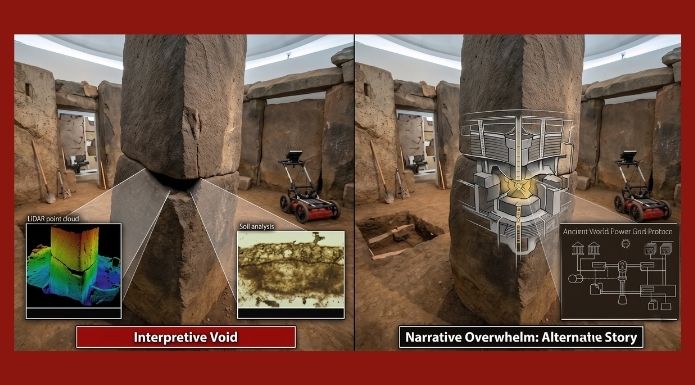
Why Archaeology Can’t Debunk Graham Hancock: The Charlatan Problem

In a recent video, Rebecca Watson (Skepchick) takes a deep dive into the claims of Graham Hancockk the man behind Netflix’s Ancient Apocalypse. Watson, alongside other skeptics, does a fine job of puncturing Hancock’s “lost civilization” theories. To be clear: this isn’t a critique of her facts. Her assessment of Hancock as a charlatan is spot on. However, there is a recurring misconception in these videos, one shared by the public and the academic community alike, that this is a battle of Science vs. Pseudoscience.

Privacy Overview

This website uses cookies so that we can provide you with the best user experience possible. Cookie information is stored in your browser and performs functions such as recognising you when you return to our website and helping our team to understand which sections of the website you find most interesting and useful.