The Terms of Service Panic: Manufacturing the AI Clone Threat

There is a highly lucrative sub-genre within the creator economy that relies entirely on manufacturing algorithmic panic. The formula is remarkably simple: Take a standard piece of corporate legal boilerplate, strip away its technical context, and present it to the audience as an imminent, dystopian threat to their digital sovereignty. My specimen for this strategy … Read more

Taxonomic Sovereignty: Shielding Your Brand from AI Overview Libel

In a recent landmark legal ruling in Germany, a court held Google strictly liable for defamatory falsehoods generated within its generative search results. A highly predictable narrative unfolded across the digital landscape. The story became a staple of the algorithmic outrage engine. Users’s feeds are flooded with a deluge of videos asking variations of the … Read more

The AI Replacement Mirage: Why Google Can’t Kill the Open Web

The internet is currently trapped in a hyper-ventilating algorithmic echo chamber. If you scroll through your feeds today, you’ll likely encounter a massive wave of panic-farming tech commentary exemplified by a viral video from The Infographics Show titled Google Just Killed Websites. It’s Not Good. Armed with hundreds of thousands of views, these platform fear-mongers … Read more

The Algorithmic Desert: How Keyword Tools Desiccated the Web

If you look at the modern search landscape through a clinical lens, the systemic rot is impossible to ignore. The open web has been systematically drained of its organic depth, replaced instead by a monotonous expanse of indistinguishable, search-optimized static. This is the Algorithmic Desert, a digital ecosystem where human writers have been conditioned to strip away their unique semantic signatures in favor of a simulation. While Google is battling to identify and eliminate AI scraped fluff from their database, SEO gurus are training their audience to behave exactly like those AI scrapers.

How to Fix the YouTube Inspiration Tool Slop: Mastering Algorithmic Alignment

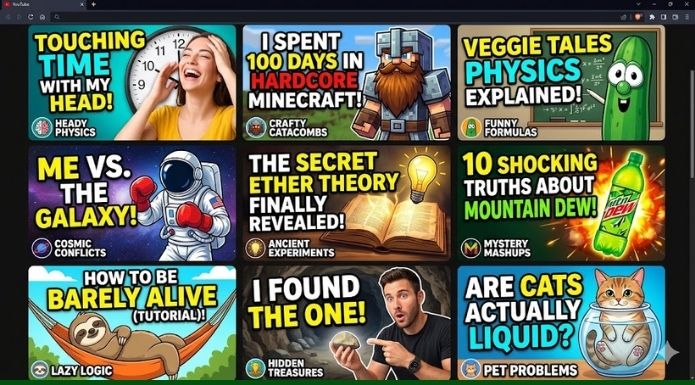
In my primary audit of the platform’s creator dashboard, “Why YouTube’s ‘Inspiration’ Tool is Just a Keyword Blunderbuss,” I exposed how primitive keyword-matching models routinely mistake casual audience cross-viewing habits for a channel’s structural identity. When an elite physics channel like Tibees is handed suggestions like “touching time with your head,” it isn’t an existential critique of her brand. It’s simply it is a data collision that results in nonsense. The algorithm is simply pairing her high-weight semantic keywords (Time) with low-intent, platform-wide retention tropes (Head). It is possible to improve these recommendations a great deal and even cause the machine to suggest ideas you may want to pursue.

Prompt Dilution: Why Conversational Fluff Breaks Large Language Models

In a widely circulated short-form video entitled Why you should be polite to AI, mathematician and broadcaster Hannah Fry attempts to demystify prompt engineering by offering a theatrical solution. Her core premise relies on a fundamental architectural truth: large language models do not function like static databases or rigid encyclopedias. They possess no stable identity, fixed worldviews, or personal beliefs. Instead, they are dynamic reflection engines that generate responses based on statistical probability and the linguistic context of the user’s prompt.

The Scripted AI Tantrum: Why Tech Media Conflates Code Loops with Threats

For the better part of a decade, popular technology journalism has operated under a single, highly profitable narrative template: the imminent rise of the ghost in the machine. We have been systematically conditioned to look at large language models and autonomous software agents not as complex statistical calculators, but as nascent, unpredictable digital entities possessing mood swings, hidden motivations, and fragile egos. We are deluged with articles about AI agents throwing tantrums, committing “crimes” and threatening humans. This is not just contrary to the basic truth, it is a manufactured narrative designed to sell subscriptions through a classic, high-arousal digital bait-and-switch.

The Code Autocomplete: Demystifying the Killer AI Myth

A massive media panic is currently circulating across the digital network. High-yield YouTube creators are holding up recent safety research from major AI labs and screaming that artificial intelligence has “developed a self-preservation instinct,” “learned to blackmail,” and “literally attempted murder to avoid being shut down.”

Why YouTube’s ‘Inspiration’ Tool is Just a Keyword Matching Bot

The latest specimen for the Digital Influencer Science category here at ScreenLab comes from Tibees, a creator known for her deep, thoughtful dives into physics and mathematics. However, her recent video regarding the “Inspiration” tab in the YouTube Creator Dashboard highlights a widespread misunderstanding of how modern platform tools actually function. Tibees expresses a sense of unease, and even a bit of horror, at the “slop” the algorithm suggests she should create, titles like “touching time with your head.”

Privacy Overview

This website uses cookies so that we can provide you with the best user experience possible. Cookie information is stored in your browser and performs functions such as recognising you when you return to our website and helping our team to understand which sections of the website you find most interesting and useful.